Starting a forex brokerage takes more than a licence and a trading platform. The business needs a defined target market, a workable execution model, sufficient capital, banking and payment arrangements, CRM and KYC processes, liquidity, trading technology, qualified staff and a client-acquisition plan.
These decisions affect one another. The regulator and licensing framework influence capital requirements and access to payment providers. The execution model determines the broker's liquidity and risk-management needs. The trading platform shapes the client experience, daily operations and the scope for future growth.
This guide is intended for:
- Fintech entrepreneurs entering the FX/CFD industry
- Financial companies expanding into brokerage services
- Existing brokers entering new markets or launching another entity
This article provides general information only. Licensing, capital and compliance requirements vary by regulator and target market. Always seek advice from qualified legal, compliance and tax professionals before establishing a brokerage.
Launch roadmap at a glance
- Choose your brokerage model
- Define your target market and brokerage proposition
- Select a regulator and licensing route
- Define your execution and risk model
- Build your business plan and initial financial model
- Build the core team and assign operational ownership
- Build your technology and operational infrastructure
- Define your marketing and client-acquisition strategy
- Build your website
- Test and launch
This guide also explains the costs and timelines involved in starting a brokerage.
1. Choose your brokerage model
White-label forex brokerage
A white-label broker operates under its own brand using infrastructure provided by an established broker or technology provider. This may include the trading platform, hosting, liquidity, CRM, payments, back office and operational support. The agreement should clearly define who controls client data, execution, payments, reporting, support and third-party connections.
A white-label setup can speed up technology deployment, but you still need to address licensing, compliance, banking, staffing and client acquisition. It can also increase provider dependency if the broker later needs another platform, LP, product or regulatory market.
The cTrader white-label programme provides brokers with a branded FX/CFD platform across mobile, web and desktop. It includes hosted infrastructure, cTrader Admin and integrations with CRM, liquidity, payments, analytics and back-office systems.
Introducing broker
An introducing broker focuses mainly on distribution and client relationships while a principal broker provides the regulated brokerage infrastructure. It can be a useful route for a business that wants to test demand or build a client base before taking on the cost and responsibility of running a brokerage. The trade-off is limited control over pricing, product scope, execution and the client experience.
Independent brokerage setup
An independently operated brokerage controls its regulatory entity, commercial relationships, technology decisions and operational processes. This does not mean building every system in house. Most independent brokers combine established components such as a trading platform, CRM, KYC solution, liquidity bridge, payment infrastructure and reporting tools. The difference is that the brokerage selects and manages these relationships directly.
The model gives the business more control over pricing, liquidity, execution, platform strategy and client experience. It also demands more capital, specialist expertise and operational responsibility.
Factor | White-label brokerage | Independent brokerage |
Launch speed | 1–3 months | Typically 6–18 months for a fully regulated launch, depending on licensing and operational requirements |
Initial investment | Moderate ($50,000–$150,000) | Higher ($350,000–$800,000+) |
Brand control | Moderate to high | Highest |
Execution control | Depends on the arrangement | Highest |
Technology responsibility | Shared with the provider | High |
Client relationship and data control | Defined by the agreement | Direct |
Compliance responsibility | Depends on the regulator and market | Direct |
Scalability | Depends on the provider | Flexible |
2. Define your target market and brokerage proposition
Then you need to define who the brokerage intends to serve and what it will offer. These decisions will affect the regulatory permissions required, the products and trading conditions, payment methods, platform capabilities and client-support setup.
Define your target market
“Retail forex traders” is too broad to support the decisions that follow. Narrow the target audience by considering:
- Countries and regions – where the brokerage intends to acquire and serve clients
- Client type – retail, professional or institutional
- Trading profile – discretionary, copy, algorithmic or mobile-first traders
- Language and service expectations – supported languages, customer-support hours and localisation needs
- Funding preferences – currencies and payment methods commonly used in the target markets
Define the brokerage proposition
Once the target audience is clear, decide what the brokerage will offer them:
- Will the broker focus on FX or provide a wider CFD range?
- Which account types will be available?
- How will spreads, commissions and other trading charges be structured?
- Which trader segments should the platform and product offering support?
- What will distinguish the brokerage from competitors serving the same market?
3. Select a regulator and licensing route
The regulator and licensing framework affect which activities the brokerage can perform, how much regulatory capital it may need and which compliance requirements it must meet. They can also affect access to banks, payment providers, liquidity providers and other counterparties.
The licensing route depends on the brokerage model selected in step 1. An independent brokerage will usually manage the authorisation process directly, while a white-label setup may operate under a different regulatory arrangement depending on the provider, regulator and client relationship.
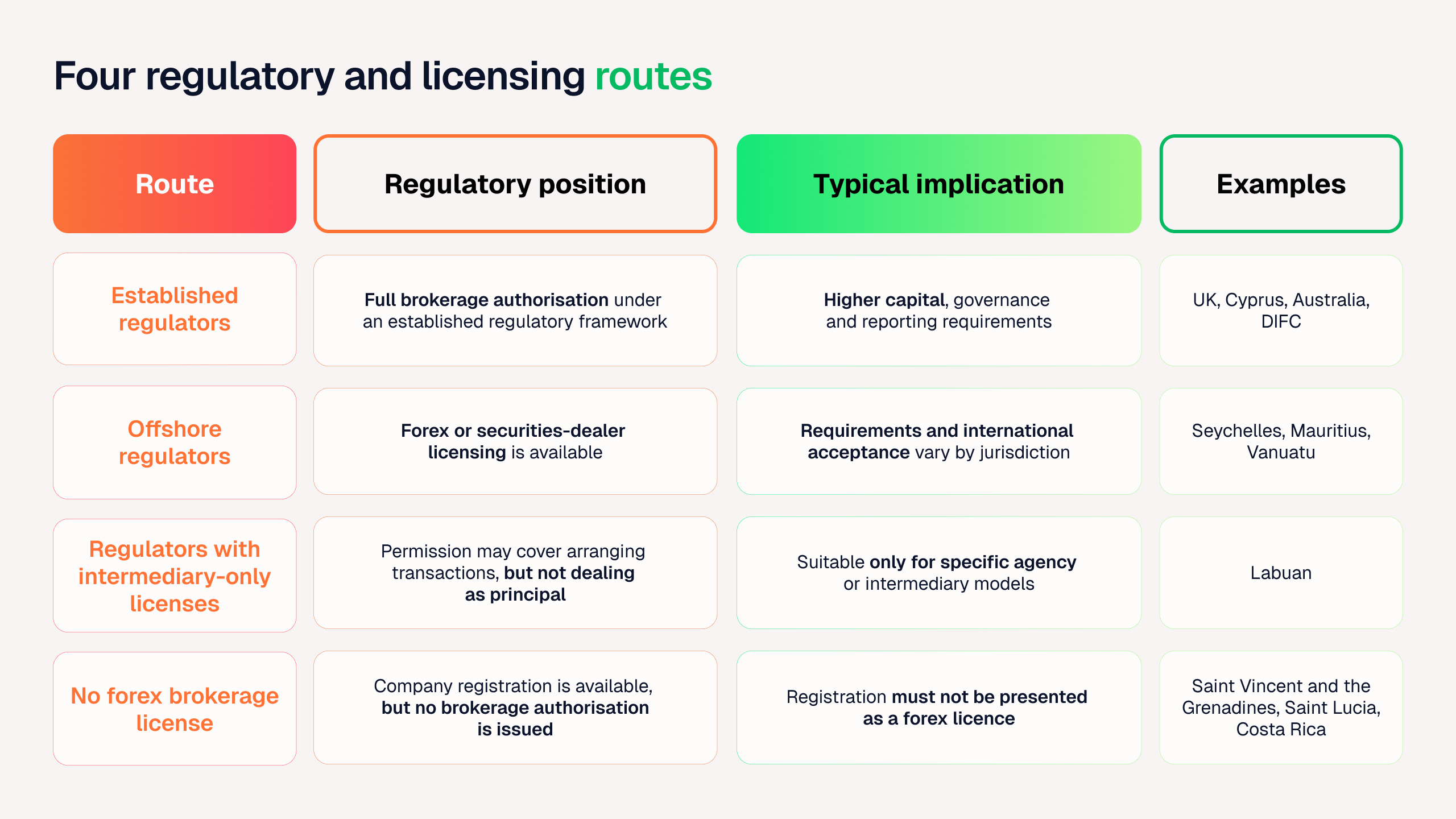
Established regulators
Licensing requirements, permissions, capital, local presence, client-money rules and reporting obligations vary by regulator.
Examples include:
- Financial Conduct Authority (FCA), United Kingdom: brokers need FCA authorisation.
- CySEC, Cyprus: brokers are regulated under MiFID II.
- Malta Financial Services Authority (MFSA), Malta: brokers are regulated under MiFID II.
- Australian Securities and Investments Commission (ASIC), Australia: brokers generally need an Australian Financial Services licence.
- Dubai Financial Services Authority (DFSA), DIFC: brokers operating in the DIFC need DFSA authorisation.
- Financial Sector Conduct Authority (FSCA), South Africa: brokers are regulated by the FSCA.
Offshore regulators
Offshore does not necessarily mean unregulated. Several offshore regulators license forex/CFD brokers, but requirements, supervision and international acceptance vary between regulators.
Examples include:
- Financial Services Authority (FSA), Seychelles: issues Securities Dealer licences.
- Financial Services Commission (FSC), Mauritius: issues Investment Dealer licences, including licences covering currency derivatives.
- Vanuatu Financial Services Commission (VFSC), Vanuatu: issues Financial Dealers licences.
These licences may offer a more accessible route for brokers targeting international markets. However, the decision should not be based on licensing cost or speed alone. Banking, PSP availability, liquidity-provider acceptance and restrictions on the countries the broker can target should all be checked before choosing a regulator.
Some broker groups operate through more than one regulated entity under different regulators. Each licence applies to the entity, activities and client base within its scope, so additional authorisations do not remove local or cross-border restrictions.
Regulators offering intermediary-only licences
Some regulators offer licences that allow a firm to arrange or intermediate transactions without dealing as principal. For example, Labuan FSA licenses money brokers to bring buyers and sellers together and receive brokerage or commission fees, but not to buy or sell foreign currencies as principal.
This route may support an agency or intermediary model, but it is not suitable for a brokerage that intends to internalise exposure or act as a market maker.
Markets without a dedicated forex brokerage regulator
Some markets are promoted as inexpensive forex licensing routes even though they provide company registration rather than regulatory authorisation for brokerage activities.
Examples include:
- Saint Vincent and the Grenadines: The authorities state that no forex trading or brokerage licences are issued there. A registered company is not a licensed forex broker. See the official forex trading advisory.
- Saint Lucia: The Financial Services Regulatory Authority has warned that documents claiming a forex company is licensed or affiliated with the authority may be false or misleading.
- Costa Rica: SUGEVAL has published a public warning concerning forex investment activity. Company incorporation should not be presented as authorisation to provide regulated brokerage or securities services.
A company registration should never be described to clients, banks, liquidity providers or payment providers as a forex licence. The business may still need authorisation in every market where it conducts regulated activities or serves clients.
What to check before choosing a regulator
- Permitted activities and whether the firm may deal as principal
- Target markets and cross-border restrictions
- Minimum and ongoing regulatory capital
- Local office and management requirements
- Client-money rules
- Reporting, audit and compliance obligations
- Banking and payment-provider availability
- Acceptance by liquidity providers and other counterparties
- Product, leverage and marketing restrictions
- Expected approval time and ongoing operating costs
4. Choose your execution model
A broker must decide how it will manage client orders and the resulting market exposure. The three common models are A-book, B-book and hybrid execution.
Model | Basic approach | Main requirements |
A-book | Orders or resulting exposure are routed to external liquidity | LP connectivity, routing controls and execution monitoring |
B-book | The broker internalises the exposure | Exposure limits, pricing controls and risk-management processes |
Hybrid | The broker internalises or routes exposure according to defined rules | Segmentation, routing logic, monitoring and governance |
Which model is right for you?
- A-book is generally better suited to brokers that want to minimise retained market exposure and are comfortable relying on external liquidity and execution partners.
- B-book may suit brokers with strong dealing and risk-management capabilities that are prepared to manage market exposure internally.
- Hybrid is better for more mature brokerages that want flexibility in how different types of flow are handled and have the data, controls and dealing expertise to manage a more complex setup.
5. Build your business plan and financial model
Use your brokerage model, target markets and licensing route to estimate capital needs, operating costs and revenue. Test viability before committing to providers.
Business plan checklist
- Revenue assumptions – expected income from spreads, commissions, swaps and other permitted services
- Client and trading forecasts – expected registrations, funded accounts, deposits and trading activity
- Regulatory capital – requirements arising from the selected licence and permissions
- Initial technology budget – indicative costs for the trading platform, CRM, KYC, reporting and other systems
- Liquidity and execution budget – expected deposits, collateral, connectivity and bridge costs where applicable
- Banking and payment budget – account fees, PSP charges, reserves and payment-processing costs
- Indicative staffing costs – required internal roles, salaries and functions that may be outsourced
- Marketing budget – an initial allowance for direct acquisition, affiliates, IBs, partnerships and localisation
- Professional services – legal, compliance, accounting and audit expenditure
- Operating runway – working capital required before the brokerage reaches sustainable revenue
- Financial scenarios – base, downside and growth cases
- Contingency and wind-down reserves
The financial model should be updated as actual provider costs, staffing requirements and marketing budgets are confirmed. A downside scenario should also allow for delays in licensing, banking, technology setup or client acquisition.
6. Build the core team and assign operational ownership
Once the business plan establishes what the brokerage can support, define the people needed to operate it.
Define the core functions
A brokerage will typically need ownership across:
- Executive management – strategy, governance and regulatory accountability
- Compliance and AML – onboarding controls, monitoring, reporting and regulatory obligations
- Dealing and risk – exposure, execution, liquidity relationships and trading controls
- Finance – client-money processes, reconciliation, accounting and financial reporting
- Brokerage operations – account administration, trading conditions and day-to-day provider coordination
- Technology – platform setup, integrations, access management and technical incidents
- Customer support – client queries, platform assistance and escalation
- Sales and partnerships – commercial relationships, IBs and affiliates
- Marketing – positioning, acquisition campaigns, content and performance measurement
Not every function needs a separate department at launch. A smaller brokerage may combine responsibilities or outsource selected functions where permitted.
Decide what to keep in house and what to outsource
Consider:
- Which positions require specific qualifications or approval
- Which functions need direct day-to-day control
- Which specialist services can be outsourced
- Whether providers offer operational support as part of the brokerage setup
- How responsibilities will be divided between internal staff and external partners
7. Build your technology and operational infrastructure
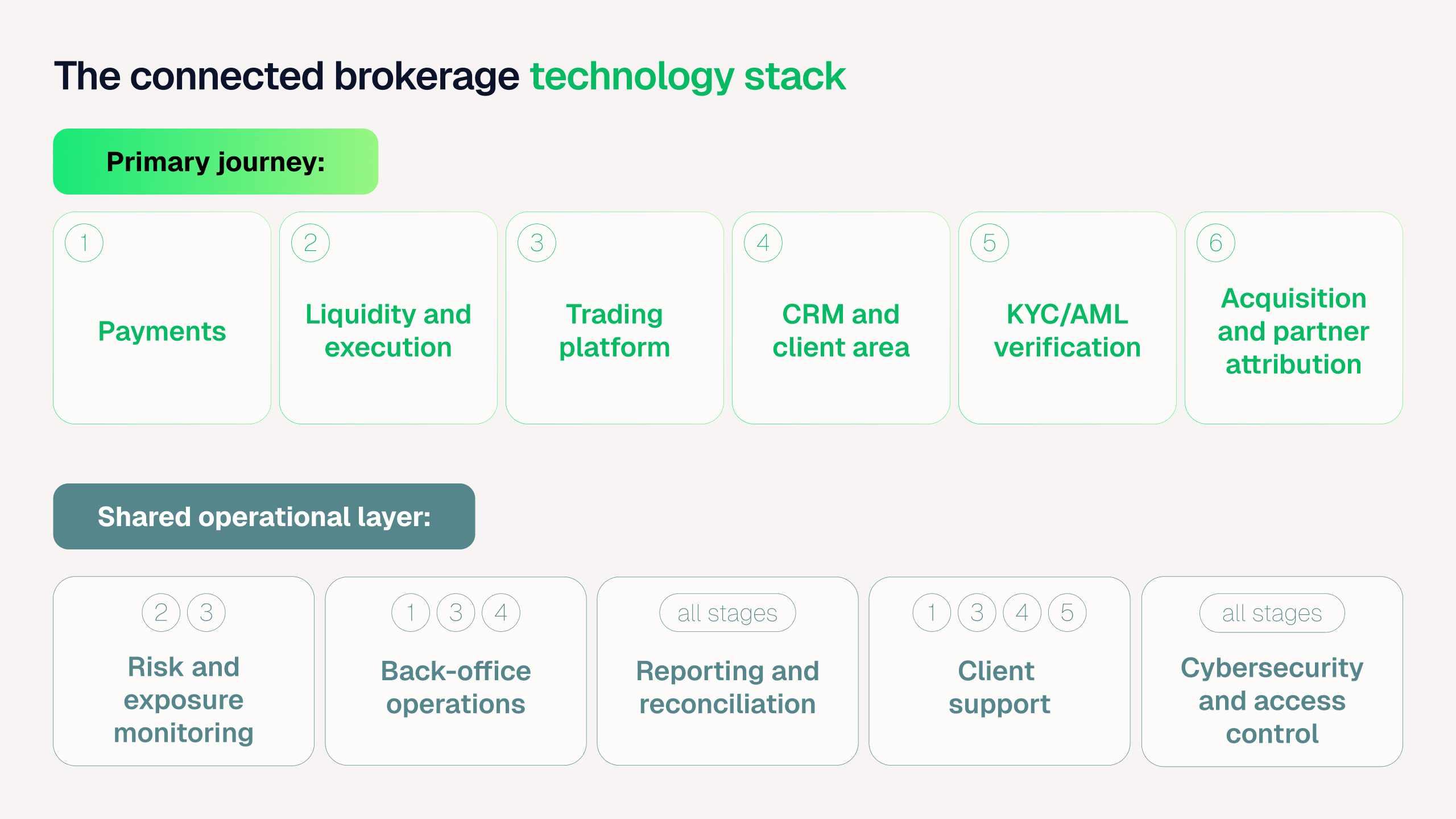
Build the systems as one connected operation. Before selecting providers, define data ownership and integration requirements. Banking, liquidity and technology workstreams can run in parallel, subject to their commercial and regulatory dependencies.
7.1. Establish banking and payment infrastructure
A brokerage needs reliable banking and payment routes before it can accept and return client funds.
The setup may include:
- Corporate banking
- Segregated client-money accounts where required
- Payment service providers
- Card processing and bank transfers
- Local and alternative payment methods
- Multi-currency support
- Deposit and withdrawal workflows
- Chargeback management
- Payment reserves
- Transaction monitoring
- Daily reconciliation
What to consider when setting up payments
- Start bank and PSP discussions early – financial-services businesses usually face detailed due diligence, and a licence does not guarantee payment access.
- Plan for more than one payment route – outages, policy changes or higher reserve requirements can disrupt deposits and withdrawals, so avoid dependence on a single provider where practical and compliant.
- Check integration requirements upfront – payment providers should be able to exchange account and transaction data with the CRM, client area and trading platform.
7.2. Secure liquidity and define execution connectivity
With the execution model already defined, the next step is to secure the liquidity relationships needed to support it and determine how the brokerage will connect to those providers.
A-book and hybrid brokers need external liquidity for the flow they route or hedge outside the brokerage. B-book brokers may also use liquidity providers selectively for hedging, pricing or managing exposure.
Choose your liquidity providers
Compare:
- Instrument coverage
- Price depth
- Spreads in normal and volatile markets
- Execution speed and fill quality
- Slippage and rejection rates
- Margin, collateral and deposit requirements
- Credit and settlement terms
- Reporting and technical support
- Counterparty stability
Execution quality should be tested before launch and monitored afterwards. Attractive pricing is of limited value if orders frequently experience poor fills, excessive slippage or rejections.
Decide between direct LP connectivity and a liquidity bridge
The right connectivity setup depends on the number of liquidity providers, trading platforms and the level of execution control the brokerage needs.
With direct connectivity, the trading platform connects directly to a liquidity provider. cTrader supports direct LP connections, which can suit a simpler setup with one main liquidity source.
Brokers working with multiple LPs will generally need an additional layer to aggregate prices and manage how orders are routed between providers. This is where a liquidity bridge becomes relevant.
cBridge is Spotware’s standalone liquidity bridge, connecting cTrader, MT4, MT5 and FIX API environments to multiple liquidity providers. It brings liquidity aggregation, routing, monitoring and execution reporting into one back-end environment. For qualified brokers, the cBridge Markout Report adds intraday markout and pre-trade drift analysis to assess execution performance and refine routing decisions.
For a more detailed comparison of bridge functionality, pricing and provider selection, see our guide to choosing a liquidity bridge.
7.3. Choose the trading platform
With liquidity requirements and execution needs defined, the trading platform can now be assessed against a clearer operational brief.
The trading platform is where clients experience the brokerage. It also affects administration, infrastructure, integrations, partner operations and the broker's ability to serve different trader segments.
Assess platforms across three areas:
Trader experience
- Web, mobile and desktop availability
- Platform stability and responsiveness
- Charting and order functionality
- Customisable workspaces
- Copy and algorithmic trading
- Language support
- Cross-device account access
Broker operations
- Account and user administration
- Symbol and trading-condition configuration
- Permissions and access controls
- Exposure and execution visibility
- Reporting and reconciliation
- Infrastructure and maintenance requirements
- Support and incident procedures
Commercial flexibility
- Branding and customisation
- CRM and client-area integrations
- Partner and IB tools
- APIs and custom workflows
- Compatibility with a multi-platform strategy
- Total cost of ownership
- Capacity to add markets, instruments and services
Fast deployment should not be the only criterion. A restrictive platform can reduce the workload at launch but create integration limits, maintenance costs or vendor dependency later.
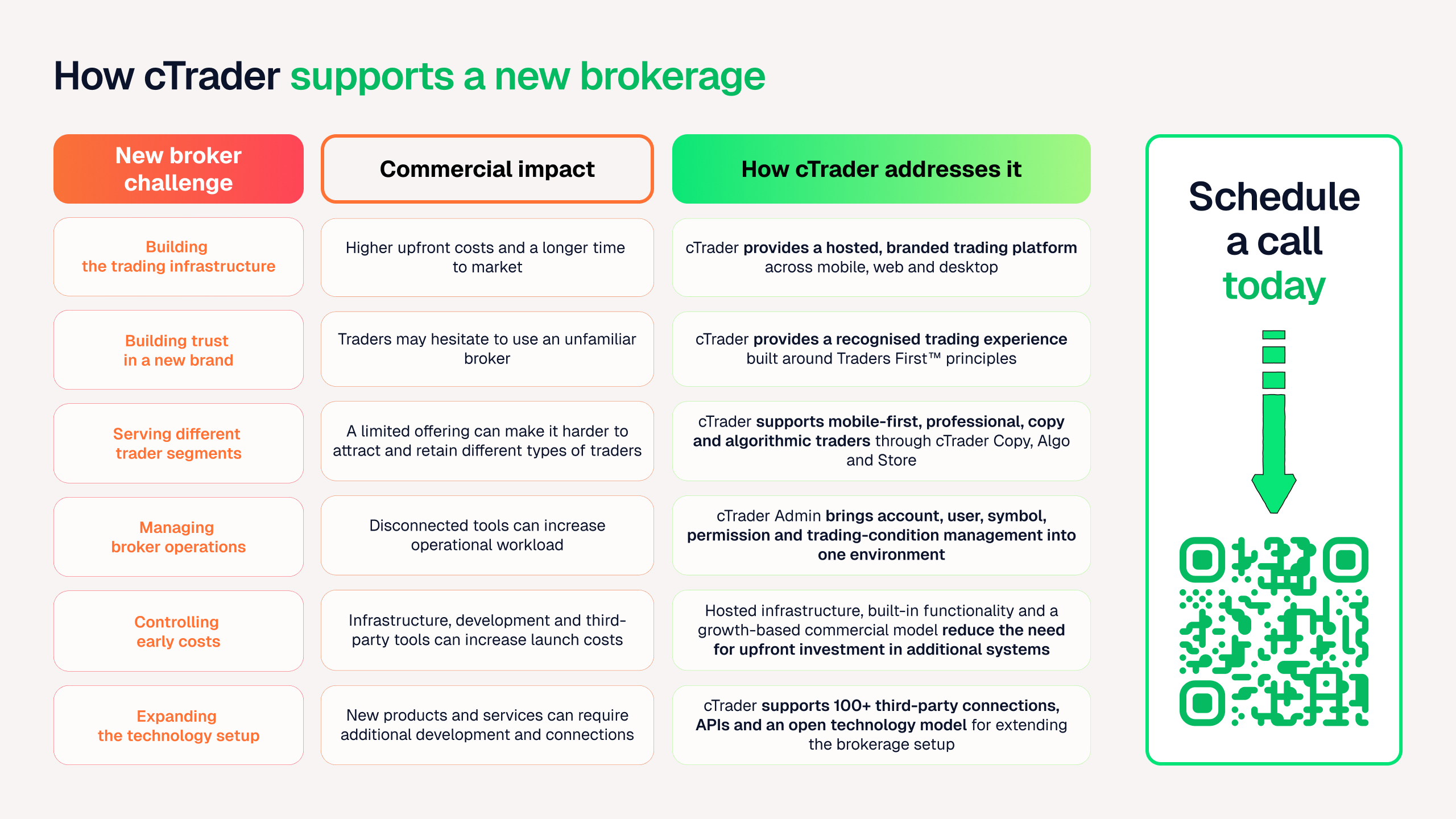
cTrader for FX/CFD brokers provides a complete trading infrastructure with an open integration model. Its mobile, web and desktop applications deliver a best-in-class trading experience, while hosted technology and broker management tools support the operational side of the business. This gives emerging businesses an established foundation for launch while allowing them to shape their technology stack, offering and client experience around their own business model.
Build a stronger trader proposition
cTrader can serve different trader segments from the outset, including mobile-first, professional, copy and algorithmic traders.
cTrader Copy gives clients access to a cross-broker pool of strategies and connects brokers with both copy investors and strategy providers. cTrader Algo supports C# and Python, backtesting and free 24/7 cloud execution for cBots, with no VPS required.
cTrader Store adds thousands of cBots, indicators, plugins and copy strategies, giving traders more ways to personalise their setup. Its affiliate model also allows IBs and partners to earn commissions from eligible purchases by referred buyers and sales by referred sellers alongside their broker commissions.
Manage accounts and operations in one place
On the operational side, cTrader Admin gives broker teams control over accounts, users, symbols, permissions, trading conditions and risk settings.
A range of additional functionality is available within cTrader at no extra cost, including market news, an economic calendar, executable TradingView signals and spread betting. Full Integration connects the broker’s CRM with cTrader, allowing clients to sign in and open live or demo accounts within the broker’s own flow without an additional login or manual account linking.
Keep early costs under control
cTrader’s commercial model allows brokers to grow without paying upfront for scale they have not yet reached. Combined with hosted infrastructure and built-in functionality, this can reduce the need for additional systems and development while giving a new brokerage room to expand its offering over time.
Together, these capabilities allow a new brokerage to launch on an established foundation, control costs and address acquisition, retention, partner growth and operations as the business develops.
7.4. Choose your CRM, client area and KYC setup
A broker CRM should do more than store contact details. It needs to connect sales, onboarding, account management, payments, partner attribution and client activity.
When comparing CRM providers, check:
- Client and lead management
- Live and demo account creation
- Trading-account data
- Sales and retention workflows
- IB and affiliate attribution
- Communication history
- Reporting and segmentation
- APIs and connections with other brokerage systems
- Role-based access for different teams
cTrader supports 100+ third-party integrations, including CRM, liquidity, risk-management, analytics and back-office solutions. This gives brokers flexibility to choose the CRM and wider technology providers that fit their operating model.
Connect registration, verification, account creation and funding in one client area. Synchronise client records with the CRM and trading platform so users do not repeat information.
Select KYC and AML tools
KYC requirements depend on the licence, target markets and client types established earlier in the setup.
Assess providers based on:
- Identity and document verification
- Address verification
- Sanctions and PEP screening
- Ongoing monitoring where required
- Support for target countries and document types
- Review and escalation workflows
- Record keeping and reporting
- Connection with the CRM and client area
The process should also account for failed or incomplete verification, manual reviews and clients whose risk profile requires additional checks.
7.5. Connect the wider brokerage technology stack
Connect the core systems with reporting, risk, partner-management, support and marketing tools. Apply cybersecurity and access controls across the stack.
Map the full flow across the brokerage:
Acquisition → registration → KYC → account creation → funding → trading → liquidity and execution → withdrawals → reporting
Assign a source of truth and an owner for each critical dataset, including client records, balances, permissions, partner attribution and reporting data.
8. Define your marketing and client-acquisition strategy
Choose your acquisition channels
Most brokerages use a mix of:
- Paid acquisition – search, social and other performance advertising
- Organic acquisition – SEO, educational content and owned media
- Partner-led acquisition – introducing brokers, affiliates and referral partners
The channel mix should reflect the target audience, geography and available budget. A brokerage built around IBs will need reliable referral attribution and partner reporting, while a direct-acquisition model will place more emphasis on campaign tracking and conversion performance.
Map the acquisition funnel
Define how a prospective trader should move through the full conversion path:
First touchpoint → registration → KYC → account opening → first deposit → first trade → continued activity
Make sure attribution can be carried through this journey so that you can identify which campaigns and partners generate funded and active clients rather than registrations alone.
Measure beyond leads
Track commercial outcomes rather than lead volume alone:
- Registration and KYC completion
- Registration-to-funded-account conversion
- First-deposit value
- Registration-to-first-trade conversion
- Cost per funded or active client
- Trading activity and retention
- Performance by channel, campaign, affiliate and IB
Marketing activity should also be reviewed against the advertising and financial-promotion requirements of each target market before campaigns go live.
cTrader acquisition opportunities
- cTrader Leads – brokers can gain visibility among 11M+ traders and attract high-intent leads at no upfront cost through cTrader Store and cross-broker cTrader apps.
- Branded mobile acquisition – brokers can promote their own branded cTrader mobile app and track campaigns through AppsFlyer SDK.
- cTrader Invite supports partner-led acquisition through tracked links, referral attribution and partner statistics. IBs can share products suited to the interests of their communities, while brokers gain clearer visibility into referred clients and partner performance.
9. Build your website
Once the acquisition strategy is defined, build the website around the audiences and conversion paths the brokerage plans to use.
The site should clearly present:
- Trading products and account types
- Trading conditions and applicable charges
- Available trading platforms
- Deposit and withdrawal methods
- Company and regulatory information
- Required risk warnings and legal disclosures
Prepare for acquisition
Create market-specific or campaign landing pages where needed and set up attribution before traffic starts.
10. Test and launch
A successful login to the trading platform does not mean the brokerage is ready. Test the business as one end-to-end operation, including the failure cases that staff will need to handle after launch.
Common launch mistakes to avoid
Most launch problems appear when regulatory, commercial and technical dependencies are handled too late or in isolation.
- Choosing a regulator mainly on setup cost or speed, without checking banking, PSP and liquidity-provider acceptance
- Starting banking and payment applications too late
- Selecting technology components separately without confirming data ownership and integration requirements
- Underestimating execution, exposure and liquidity requirements
- Treating KYC, reporting and support workflows as post-launch tasks
- Increasing acquisition before the full client journey has been tested
The pre-launch programme should cover:
- Website, registration and consent capture
- KYC approval, rejection and manual review
- Account creation and CRM synchronisation
- Deposits, withdrawals, callbacks and reconciliation
- Market data, symbols, commissions, swaps and mark-ups
- Order execution, routing, partial fills and rejections
- Exposure limits, alerts and hedging rules
- Partner attribution and IB reporting
- Permissions, password recovery and access controls
- Customer-support and complaints escalation
- Regulatory and management reporting
- Campaign tracking from source to funded account
Once the required KYC and commercial arrangements are complete, cTrader can be added in as little as five days. The process includes branding, deployment of live and demo trading servers, platform configuration, and the initial rollout of cTrader Web, Desktop, Mac, and Mobile. Branded mobile apps are released separately after app store review.
Run a controlled launch
Start with a limited client group and treat the first live activity as an operational validation period. Before increasing acquisition, confirm that:
- Clients can complete onboarding and KYC without avoidable friction
- Deposits and withdrawals work across the intended payment routes
- Execution quality, slippage, rejections and system behaviour remain within expected parameters
- Reconciliation, exposure monitoring and reporting work with live data
- IB and campaign attribution reaches the correct client and account records
- Support and escalation procedures work when something fails
- Critical issues found during the controlled launch have been resolved
How much does it cost to start a forex brokerage?
There is no standard cost. The budget depends on the regulator, licensing route, regulatory capital, brokerage model, technology scope and size of the initial team.
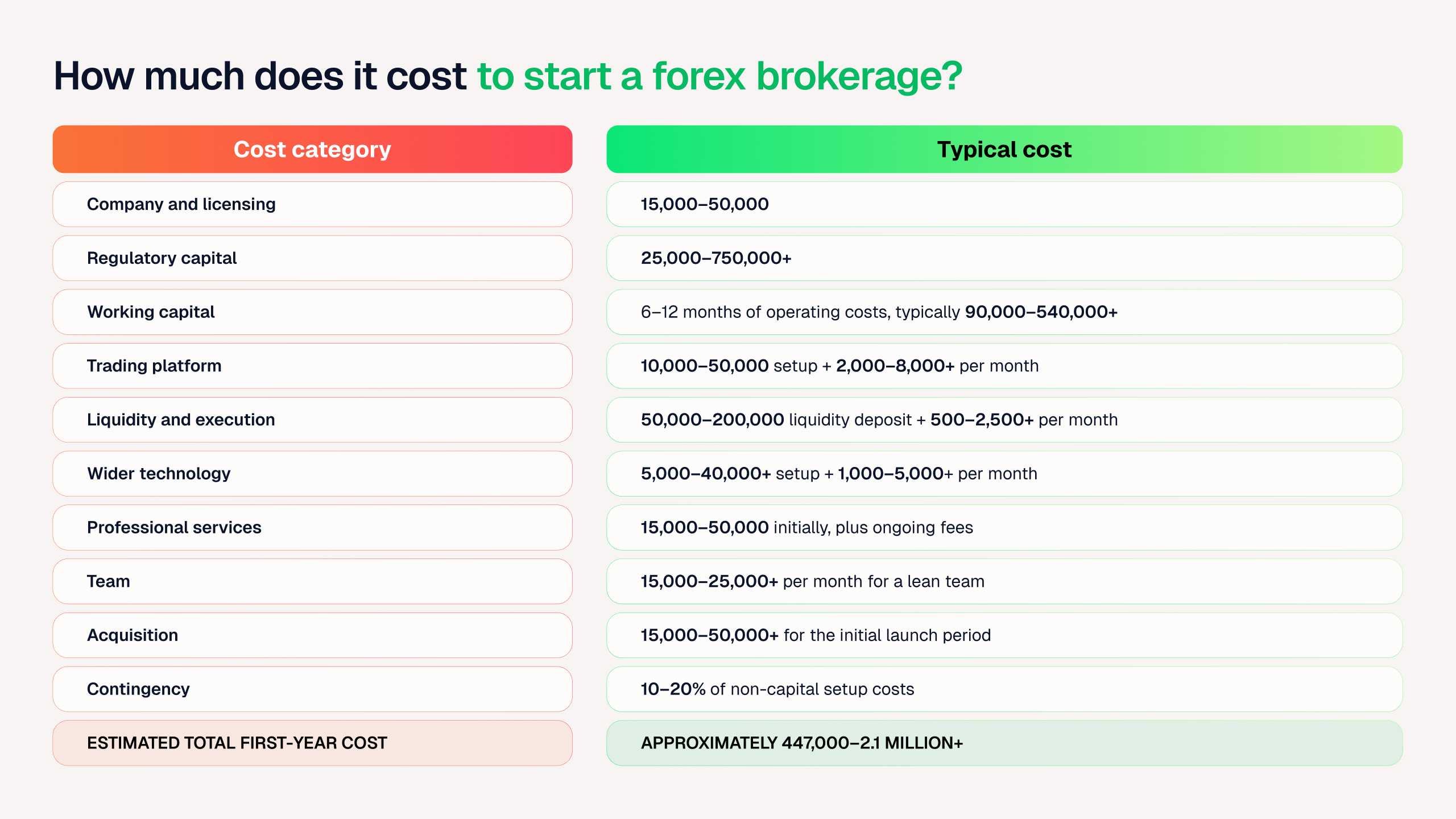
Cost category | Typical range | What it may include |
Company and licensing | $15,000–$50,000 | Incorporation, application fees, legal advice and local substance |
Regulatory capital | $25,000–$750,000+ | Capital required under the chosen permissions and applicable regulatory requirements |
Working capital | 6–12 months of operating costs, typically $90,000–$540,000+ | Cash buffer for day-to-day operating expenses |
Trading platform | $10,000–$50,000 setup + $2,000–$8,000+ per month | Setup, branding, platform fees and additional services cTrader combines branded multi-device applications, hosted infrastructure and extensive integration options, reducing setup and development costs while helping new brokers reach high-intent traders. |
Liquidity and execution | $50,000–$200,000 liquidity deposit + $500–$2,500+ per month | Deposits, connectivity, market data, bridge and reporting cBridge uses fixed infrastructure-based pricing with no volume fees, keeping bridge costs predictable as trading activity grows. |
Wider technology | $5,000–$40,000+ setup + $1,000–$5,000+ per month | CRM, KYC, back office, payments, risk tools and integrations |
Professional services | $15,000–$50,000 initially, plus ongoing fees | Legal, compliance, accounting and audit |
Team | $15,000–$25,000+ per month for a lean team | Recruitment, salaries, training and outsourced functions |
Acquisition | $15,000–$50,000+ for the initial launch period | Website, marketing, affiliates, IB commissions and localisation |
Contingency | 10–20% of non-capital setup costs | Delays, additional development and provider requirements |
Estimated first-year funding requirement | Approximately $447,000–$2.1 million+ before contingency | Includes setup costs, regulatory capital and 12 months of recurring fees. Add a contingency of 10–20% of non-capital setup costs. Actual requirements vary by regulator, market and business model. |
*Figures are indicative. Actual costs depend on the regulator, regulatory permissions, provider agreements and operating scale.
A white-label arrangement may reduce some initial technology and staffing requirements. The business still needs a realistic budget for compliance, operations, acquisition and recurring provider fees. An independent regulated brokerage will usually need more capital and a longer runway.
Ask every provider for an itemised proposal. Compare the cost over several years, including monthly minimums, transaction or volume charges, development work, data costs and the implications of a future migration.
cBridge follows the fixed infrastructure-based model, with pricing determined by the trading servers and LP connections involved rather than traded volume. In one broker case, moving to cBridge reduced monthly bridge costs from approximately $24,000 to $10,000 while supporting the same MT4, MT5 and multi-LP setup.
What affects the forex brokerage launch timeline?
The technology may be deployed in weeks. A complete regulated brokerage usually takes months to launch because licensing, banking, payment access, recruitment and compliance preparation are less predictable.
An IB arrangement is generally the quickest route because the principal broker already operates the main infrastructure. A white label can also shorten the technology stage, but it does not remove legal or regulatory requirements.
An independent brokerage must coordinate authorisation, banking, liquidity, technology, staffing and operational testing. Nevertheless, several workstreams can progress at the same time, subject to provider and regulatory dependencies:
- Regulatory and commercial preparation – authorisation, banking and PSP due diligence
- Trading infrastructure – liquidity, execution connectivity and platform configuration
- Client operations – CRM, KYC, payments, reporting and support workflows
- Commercial readiness – website, attribution, partner setup and acquisition assets
- Testing and launch – integration testing, failure scenarios and controlled rollout
The critical path is often set by the slowest external dependency rather than by technology deployment alone.
Build the plan around these dependencies. Allow time for further regulatory questions, banking due diligence, integration changes and issues found during testing.
Conclusion
Starting a forex brokerage is a business, regulatory and technology project. The chosen model determines how much control and responsibility the business takes on. The regulator and licensing framework affect market access, banking and provider relationships. The execution model defines how liquidity and risk are managed, while the technology stack turns those decisions into the daily client experience.
Before launch, the business should:
- Match the brokerage model to its capital and expertise
- Confirm the regulatory route before making commitments that are difficult to reverse
- Secure enough capital and operating runway
- Establish banking, payment and liquidity relationships early
- Choose technology for long-term operations as well as launch speed
- Test the complete client and trading workflow before scaling
Spotware supports emerging and established brokerages with cTrader and cBridge technology built for modern FX/CFD operations, platform differentiation and long-term flexibility.