
In today’s FX and CFD markets, the brokers growing fastest aren’t the ones with the biggest ad budgets - they’re the ones with strong IB networks. While traditional advertising becomes more expensive, more regulated and less trusted, Introducing Broker (IB) programmes are widely used by FX/CFD brokers as one of the key acquisition channels. Why? Because IBs don’t just advertise, they’re already inside the conversations where traders make decisions. If you’re still relying on paid campaigns alone, you’re missing the growth engine that top brokers have been using for years.
This article breaks down how IB programmes work, why they remain a key driver of FX and CFD broker growth and how hybrid commission structures can materially improve partner monetisation by combining upfront and recurring revenue. While results vary by region, partner profile, and flow quality, the core idea is simple: the right structure in the right hands delivers consistent, scalable growth.
Explore cTrader brokers and become an IB with your preferred partner.
What is an introducing broker (IB)?
An introducing broker is a commercial partner (an individual educator, community leader or corporate entity) who promotes a broker and brings new traders in exchange for commissions. While the broker handles all regulated activities such as execution, account management and KYC verification, the IB focuses on outreach, education and community engagement. In essence, IBs extend the broker’s commercial reach into networks that operate on trust capital. IBs operate inside the community-driven spaces where traders routinely interact. In many regions, trading communities form around private and semi-private channels such as Telegram groups, WhatsApp networks, Facebook communities, local trading academies, Discord servers and closed WeChat circles, etc. These environments are shaped more by peer recommendations and ongoing dialogue than by standard advertising. Paid campaigns may still reach these platforms, but IBs hold an advantage because their influence comes from established relationships, education and continuous engagement, not one-off impressions.
Their value is not simply reach, but the trust capital they hold within their communities. They speak the local language, understand cultural nuances and know what drives trading activity in their specific region. Many serve as educators or community anchors; they explain market concepts, run training sessions, translate complex information and help traders understand a broker’s onboarding and platform features. They do not (and must not) perform KYC or handle regulated processes; those remain strictly with the broker. With clear guidelines, transparent tracking and structured collaboration, brokers can channel this influence into a compliant and scalable acquisition strategy.
All in all, IBs help solve three major commercial barriers that brokers face:
Local penetration: IBs help brokers adapt to local languages, communication styles and community expectations. In regions where financial advertising performs poorly or faces stricter engagement rules, community-led outreach often resonates more effectively. IBs provide context, cultural familiarity and trusted guidance.
Cost control: Payouts are performance-based. You only pay when traders actually arrive and trade.
Network scalability: When structured with strong incentives and transparent tracking, IBs become compounding assets; they bring sub-IBs, affiliate clusters, local educators and entire trading communities. One IB can grow into a wider referral network through sub-IB networks without increasing fixed costs.
The result is a channel that delivers high-intent, community-vetted traders who tend to activate faster, trade more consistently and maintain stronger long-term value than traffic generated through conventional advertising.
Why are IB programmes a key growth engine for brokers?
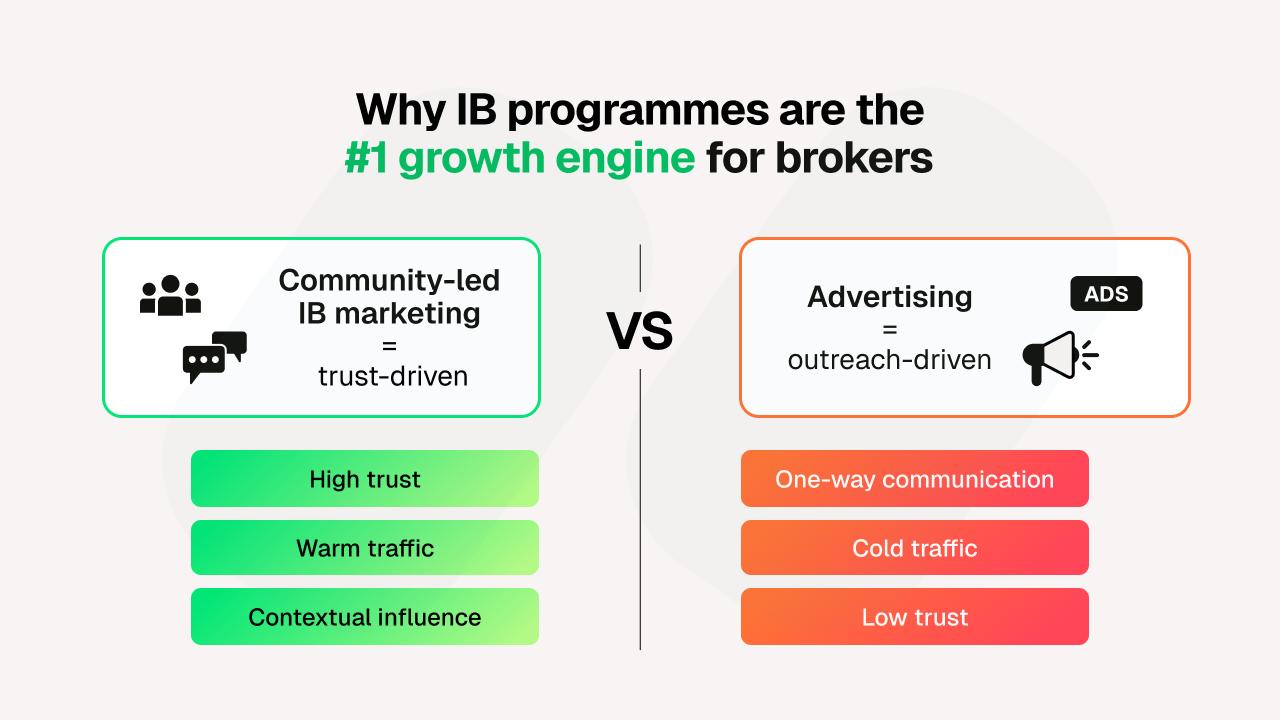
Lower client acquisition costs: In major financial markets, acquiring a funded client through paid channels can become expensive, especially in competitive or highly regulated markets. IB programmes avoid this inflation because payouts are performance-based. Brokers only compensate IBs when real trading volume is generated, making IB networks far more capital-efficient than paid advertising.
Scalable without fixed overhead: A single partner can expand into a wider sub-IB network, creating a compounding acquisition engine with no additional headcount. Tiered commission structures naturally push top performers to generate more volume while limiting exposure to underperformers. Multi-tier IB systems simplify this expansion by automating hierarchy attribution, sub-IB tracking and commission routing.
In a market where compliance tightens every year and CAC keeps rising, IB networks remain one of the most cost-effective and scalable ways to grow a broker.
Commission models: from traditional to hybrid
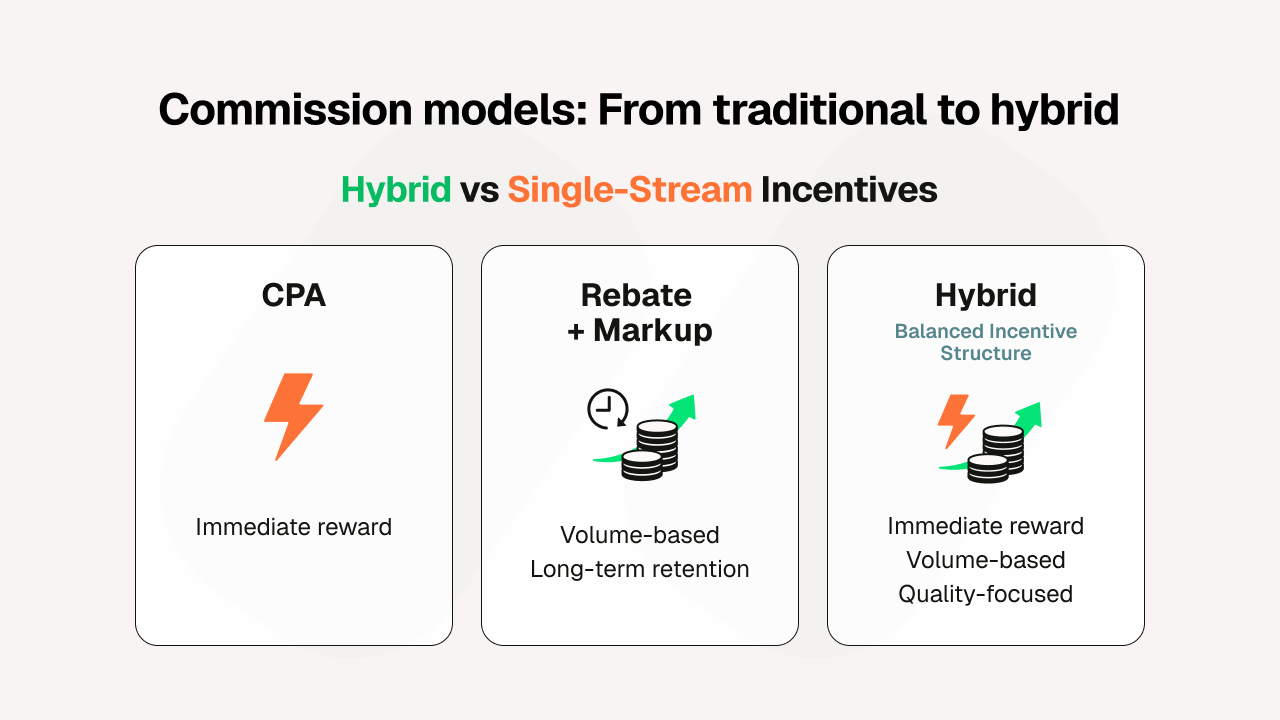
For brokers, this means higher lifetime value; for IBs, it means predictable income plus compounding revenue.
Markup and rebate models (1-dimensional)
Markup and rebate structures form the backbone of early IB programmes. Markup models add a small spread increase that the IB earns a portion of, while rebate models pay a set amount per traded lot regardless of spread changes. This keeps the mechanics simple: the broker applies a fixed markup, and the IB receives its share per lot traded. Numbers remain consistent across the industry, providing clarity without volatility.
Volume-based rebate systems follow the same logic but reward scale, with higher per-lot payouts unlocked as monthly trading activity grows. However, brokers must balance these tiers carefully as aggressive rebate payouts can compress spreads, reduce pricing competitiveness and limit long-term growth if not structured sustainably.
In some programmes, tiers may begin around $2 per lot and increase with volume. Higher tiers can reach double-digit payouts depending on the commercial model, while raw-spread or professional accounts typically operate at lower ranges due to execution cost constraints.
These models are simple to understand and easy to automate. For example, cTrader brokers can configure markups directly in the platform’s backend, with all rebate calculations generated automatically through cTrader IB analytics, ensuring accuracy across thousands of trades.
They're predictable and ideal for mature IBs running large, stable flows. However, they struggle to attract new IBs or reward account quality. Traditional rebates only reward volume, not quality. IBs can chase low-intent sign-ups and still earn, while brokers shoulder higher churn and lower monetisation efficiency.
CPA models: fast cash and misaligned incentives
Cost per acquisition models give IBs instant gratification. They get paid when a client completes Know Your Customer verification, meets deposit requirements and sometimes makes their first trade.
Depending on region, deposit threshold and qualification criteria, CPA payouts may vary widely, sometimes reaching several hundred dollars or more per qualified client. Payment cycles run weekly or monthly, and payment arrives regardless of whether the client becomes active long-term or stops after the initial deposit.
CPA gives brokers clean budget forecasting. For example, if CPA is set at a fixed rate per qualified account, costs scale linearly with acquisition volume.
However, CPA historically created misaligned incentives. A partner receives payment whether the client becomes a long-term trader or vanishes after their first deposit. Many regulated brokers tightened CPA criteria for this reason.
Improved referral tracking and attribution can help address this challenge by ensuring only verified and active clients qualify for payouts.
Hybrid models: aligning acquisition with lifetime value
Hybrid commission structures evolved as brokers needed a way to reward acquisition without creating CPA-driven distortions such as bonus hunters, low-intent registrations or CPA fraud. By blending upfront payments with ongoing volume-based rebates, hybrid schemes align incentives on both sides: brokers protect themselves from one-off, low-quality signups, while partners earn more from traders who stay active over time.
Partners receive a smaller upfront CPA combined with ongoing lot-based rebates. The exact values vary depending on region, regulatory tier, traffic quality and account type, but the structure remains the same: CPA provides immediate cash flow, and rebates turn a growing client base into recurring income. Many brokers now allow configurable splits, 40/60, 60/40, or fully customised based on IB profile, traffic quality and region.
Hybrid models unlock compounding revenue. CPA provides the upfront burst; rebates build the long tail. To illustrate, consider a simplified example: if an IB refers 30 qualified clients under a hybrid plan paying $200 CPA, the upfront payout would be $6,000 (calculated as 30 × $200). If these clients collectively generate 1,200 traded lots in the same period and the rebate rate is $4 per lot, that adds another $4,800 in recurring income (calculated as 1,200 × $4). Combined, this creates $10,800 in total earnings for the month. At scale, this difference can become commercially meaningful over time.
For brokers, the commercial benefit is measurable. In practical terms, hybrid models can help partners earn more over time because they monetise both acquisition and ongoing trading volume.
Hybrid structures also help soften revenue volatility. Unlike CPA-only structures, where revenue drops to zero the moment new referrals slow, hybrid income remains partially insulated. Even if referral flow stalls for months, under a hybrid plan, rebate revenue continues as long as existing traders remain active. This doesn't eliminate volatility, but it creates a more balanced and predictable earnings profile for both brokers and partners.
Operationally, modern IB systems support hybrid programmes by providing transparent CPA qualification tracking, automated rebate calculations and real-time reporting. This clarity reduces manual reconciliation and ensures both brokers and partners see accurate, up-to-date performance metrics.
Strategic advantages for broker leadership
Hybrid IB models aren’t just about payouts; they’re a strategic lever for broker growth. By reducing revenue risk, boosting IB retention, and enabling scalable, community-driven expansion, hybrid structures give brokers a clear edge in competitive FX/CFD markets.
Revenue stream risk distribution
Hybrid compensation reduces a broker’s exposure to volatility from any single revenue source. During market downturns, CPA-only brokers see IB commissions drop along with client trading activity, creating dual headwinds. Hybrid partners maintain rebate revenue streams, retaining IBs through volatile periods.
IB quality and retention
Hybrid models can support stronger IB retention than CPA-only structures. Income diversity creates stickiness: even if referral generation slows, IB revenue motivates continued activity.
Competitive differentiation in recruitment
Hybrid compensation structures differentiate brokers in saturated markets with identical trading platforms and spreads. Broker commission flexibility is increasingly evaluated by educational entrepreneurs, regional directors and trading community leaders. Brokers with flexible spread revenue share options and multi-level sub-IB structures attract tier-one IBs.
Reduced marketing dependency
IBs are incentivised to invest personal capital in organic acquisition channels, content, community engagement and social presence that significantly reduce brokers’ reliance on paid advertising. This dynamic shifts the acquisition cost burden from broker balance sheets to partner operations.
Multi-tier network effects
Multi-tier structures allow an IB to build their own network by assigning sub-IBs a share of rebates. This supports scalable, decentralised growth without additional operational load for the broker. For instance, a top-tier IB may give sub-IBs 70% of volume rebates and keep 30%, scaling earnings without requiring additional broker intervention. Deeper tier structures can support stronger network growth and longer partner engagement when supported by clear tracking and governance.
Together, these advantages make hybrid models not only a partner incentive structure but a strategic growth mechanism for broker leadership.
Tools that support modern IB programmes
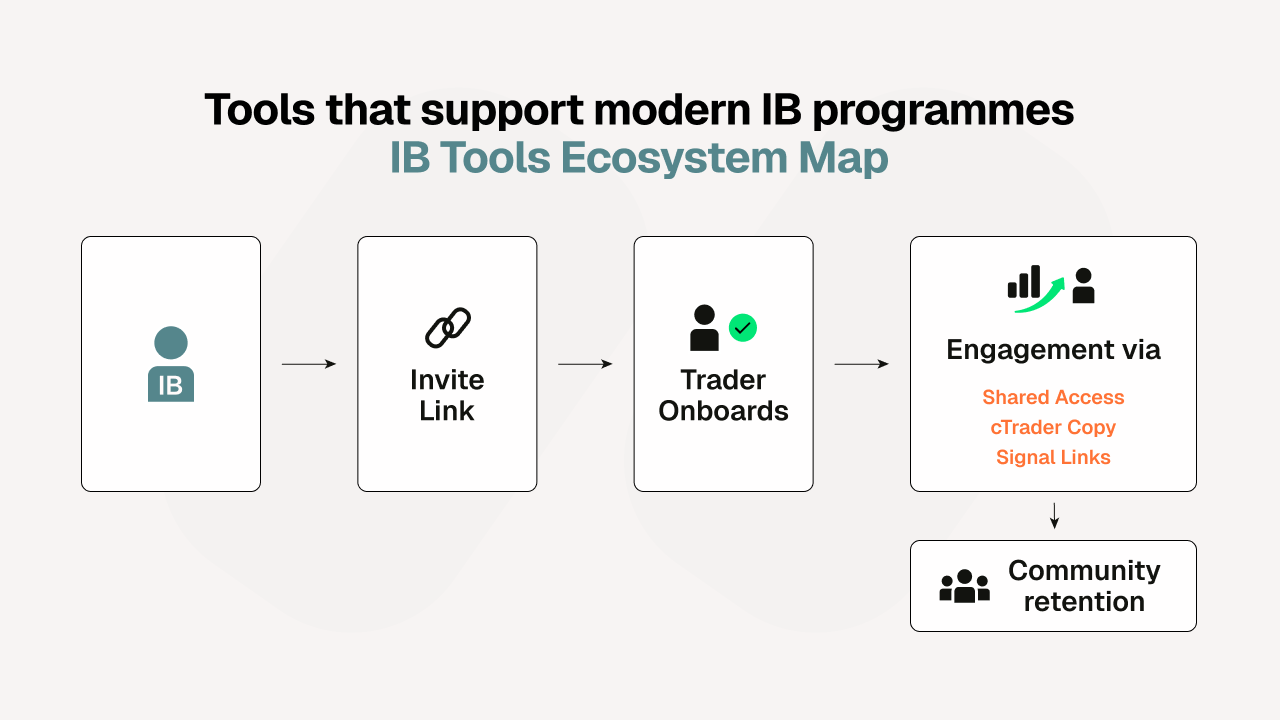
- cTrader Invite: This all-in-one referral system allows IBs to generate unique, shareable links with instant tracking, making it easy to onboard new traders.
- cTrader deeplinks: These push this further by sending prospects straight into high-intent areas of the platform (trade ticket, charts, deposit page, copying a specific strategy).
- cTrader Copy: For IBs who educate, signal or manage communities, cTrader Copy becomes a powerful retention engine.
- cTrader Algo: IBs can create, share, and run automated trading bots (cBots), increasing referral engagement and enabling 24/7 algorithmic trading without a VPS.
- cTrader widgets: Marketing-driven IBs can embed trading terminals, copy strategies and more directly into websites or landing pages to capture and convert site visitors into traders.
- Signal links: To support client engagement, signal links allow IBs to share customisable, actionable trading ideas that lead traders one tap away from placing orders.
- Sharing deals: Showcase trading achievements and promotions with QR-coded snapshots to build trust and increase social media reach.
- Shared access: Allows authorised users to monitor or manage account access based on client permissions and the broker’s internal compliance rules.
How to run an effective IB programme
To run an IB programme, you need an efficient onboarding process, tight commission tracking, solid reporting, and tight compliance oversight. Most programmes start with partner due diligence (KYC/AML), which should be completed efficiently to enable faster onboarding.
Commission accuracy is critical. Real-time tracking and clear per-trade breakdowns help maintain trust and alignment, especially in hybrid structures combining CPA, rebates and markups.
You can’t manage what you don’t measure, so regular reporting is key. Provide dashboards covering new accounts, trading volume and activity to support performance monitoring.
When evaluating IBs, look beyond volume by focusing on retention, revenue per trader and overall trading activity.
Regional compliance isn’t negotiable. Ensure your IBs understand local rules on promotions, client suitability and data handling. Clear approval workflows, audit trails and internal review processes can reduce risk.
The goal is to reduce operational complexity while maintaining transparency and compliance.
Operational considerations for brokers implementing hybrid programmes
Hybrid systems require clarity on several operational elements:
- Whether the CPA and rebate apply simultaneously or sequentially
- Exclusivity windows (e.g., CPA for an initial qualification period, then rebates)
- Tier-based CPA by region (e.g., EU might have higher rates than APAC)
- Sub-IB multi-tier splits (70/30 is a commonly used example structure, though actual splits vary by programme)
Brokers who provide partners with real-time dashboards showing CPA qualification status, rebate flows and tier progression tend to report higher partner satisfaction.
Challenges to note
Even the strongest IB programme has operational friction points. These are common challenges brokers encounter when scaling IB networks.
IB quality & flow integrity
Some IBs attract lower-intent traders or inconsistent flow, which can distort revenue forecasts. Brokers need systematic screening: activation ratios, first-deposit velocity, net trading days and chargeback patterns to maintain a healthy book.
Multi-tier network complexity
Once IBs begin onboarding sub-IBs, the operational load multiplies. Commission routing, hierarchy attribution and payout sequencing become non-trivial very quickly. Without structured IB architecture and automated reconciliation, disputes escalate, eroding trust and delaying payouts. cTrader’s multi-tier tracking mitigates most of this friction, but governance policies still need to be enforced internally.
Regional regulatory constraints
Different regions apply strict rules around financial promotions, partner licensing, communication standards and client-data handling. IBs must follow these local requirements when engaging their communities, and brokers need clear guidelines to ensure partner activity stays fully compliant as networks scale.
Attribution accuracy & commission assurance
IB relationships can deteriorate quickly if tracking accuracy is questioned. Attribution issues (broken referral links, mismatched CRM records, manual import errors) undermine credibility and stall growth. Brokers need real-time data validation, unified reporting and automated payout logic.
Aligning incentives with profitability
Commission structures must reward IB performance without eroding broker margins. High CPAs increase acquisition costs, while aggressive per-lot rebates narrow spreads. Brokers need to evaluate IB performance regularly and adjust rates based on flow quality, region and long-term value. Hybrid models help, but only when supported by rigorous performance scoring and periodic rate reviews.
Conclusion
IB programmes remain among the most cost-effective and scalable acquisition channels for FX/CFD brokers, delivering higher-intent traders, stronger retention, and better unit economics than paid marketing. Hybrid commission models push this even further by aligning short-term rewards with long-term volume.
With cTrader's IB-ready environment (transparent reporting, multi-level structures, Invite links, Copy, Algo, and automated tracking), brokers can run IB programmes that are easier to manage and scale.
For brokers aiming to scale efficiently and differentiate in competitive markets, a well-structured IB strategy powered by hybrid commissions is becoming increasingly important - it’s becoming a strategic advantage.
Explore cTrader brokers and start your IB journey with the right partner.