Trading platform pricing: active-account, volume and fixed fees
BySpotware team
23 Oct 2026•11 min read
Share this post
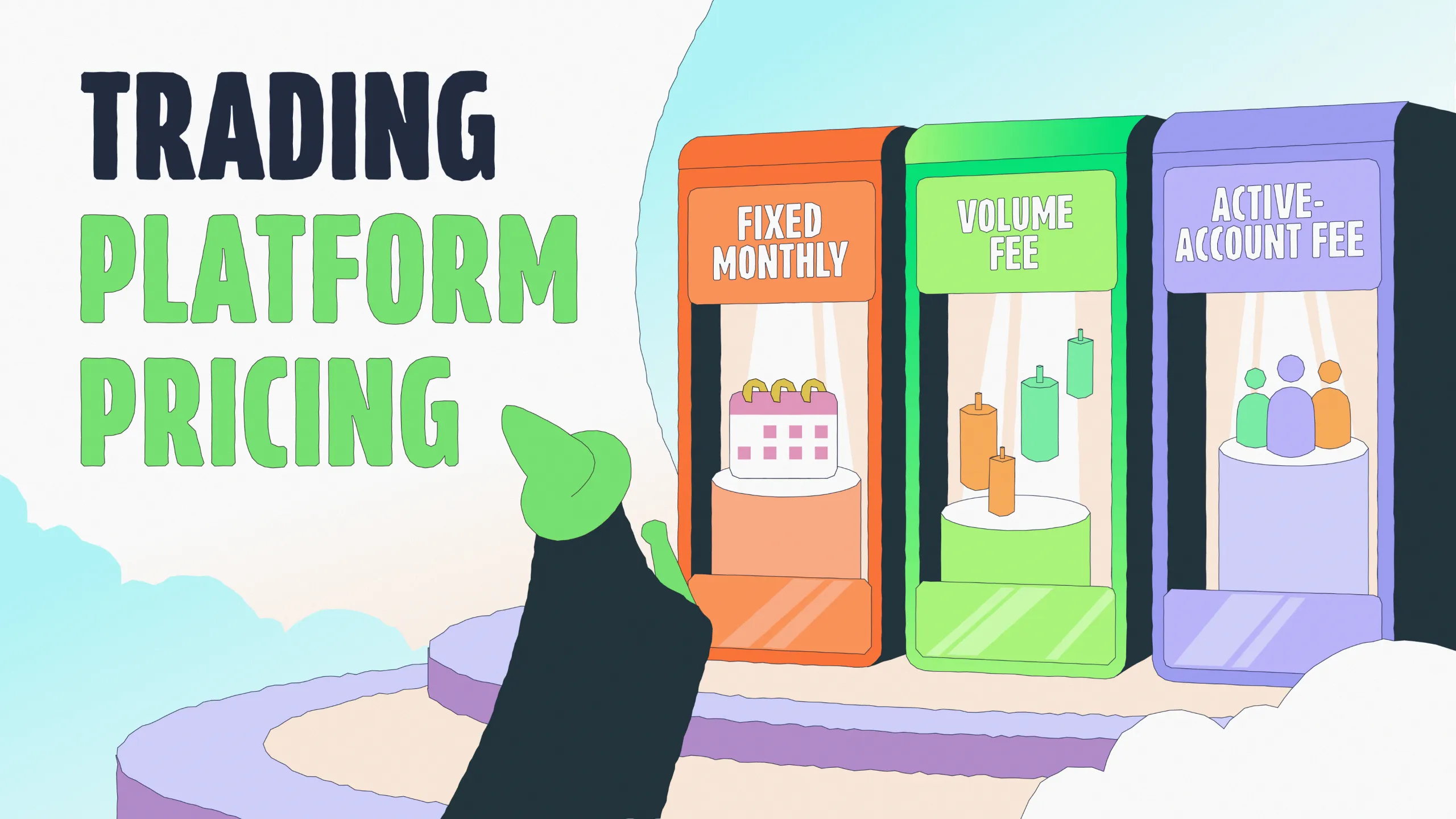
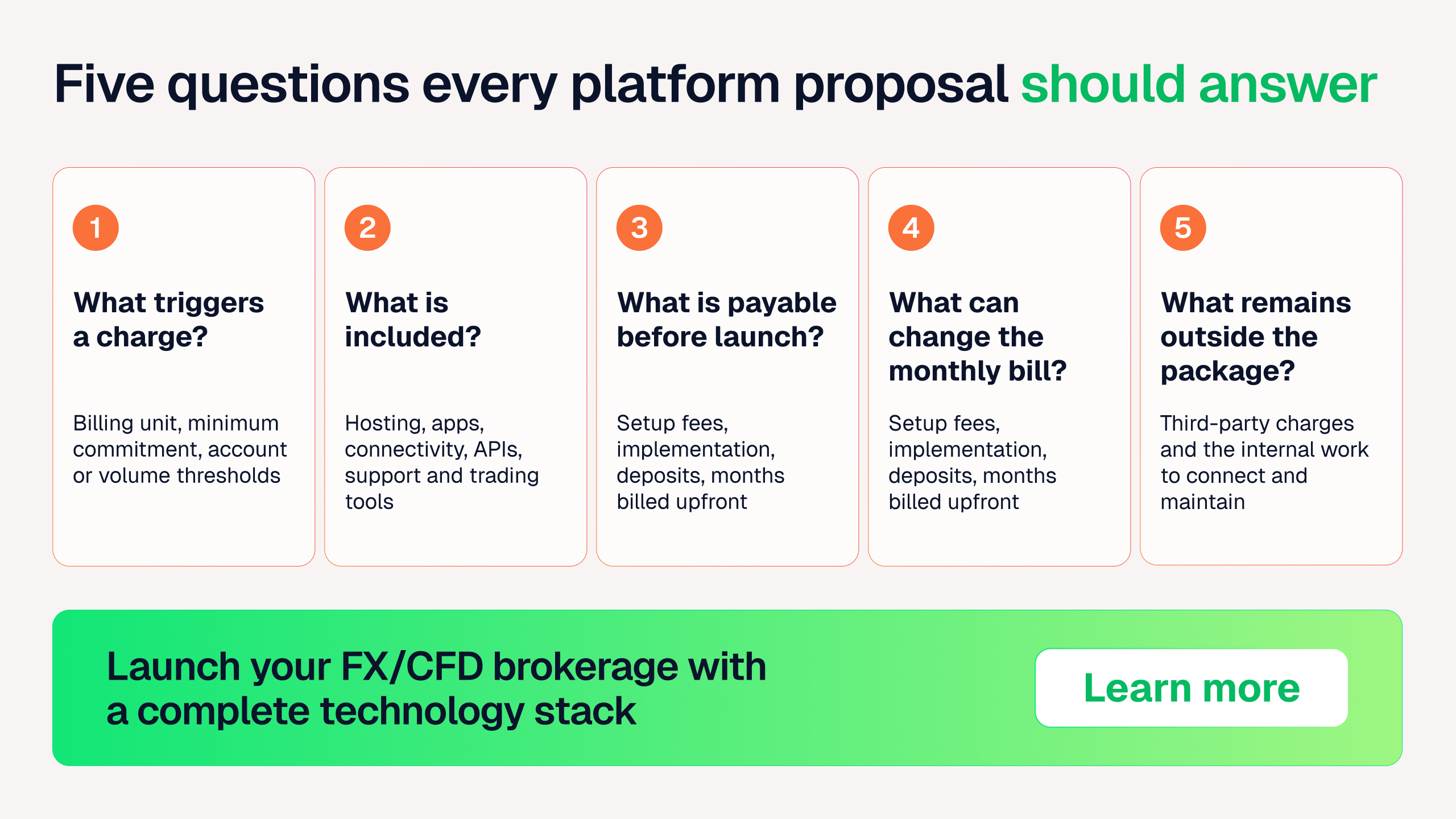
Trading platform pricing determines how your technology budget responds to client activity. For an FX or CFD brokerage, the key is to understand what triggers a charge, what the package includes and which costs sit outside it.
Active-account fees, volume fees and fixed monthly subscriptions each provide a different way to budget for platform access. Some contracts combine these elements, such as a monthly fee with an included trading volume allowance.
This guide explains how each structure works, its practical benefits and the terms to check before committing. It also looks at what matters for startup brokers and where cTrader fits into the technology budget.
At a glance
Active-account pricing: charges depend on the number of accounts that meet the provider's definition of active.
Volume pricing: charges depend on the amount of trading activity measured under the contract.
Fixed monthly pricing: a recurring fee covers a defined platform package.
Fixed monthly pricing with included volume: a recurring fee covers the package and a trading volume allowance, with additional charges above that allowance.
What does a trading platform fee cover?
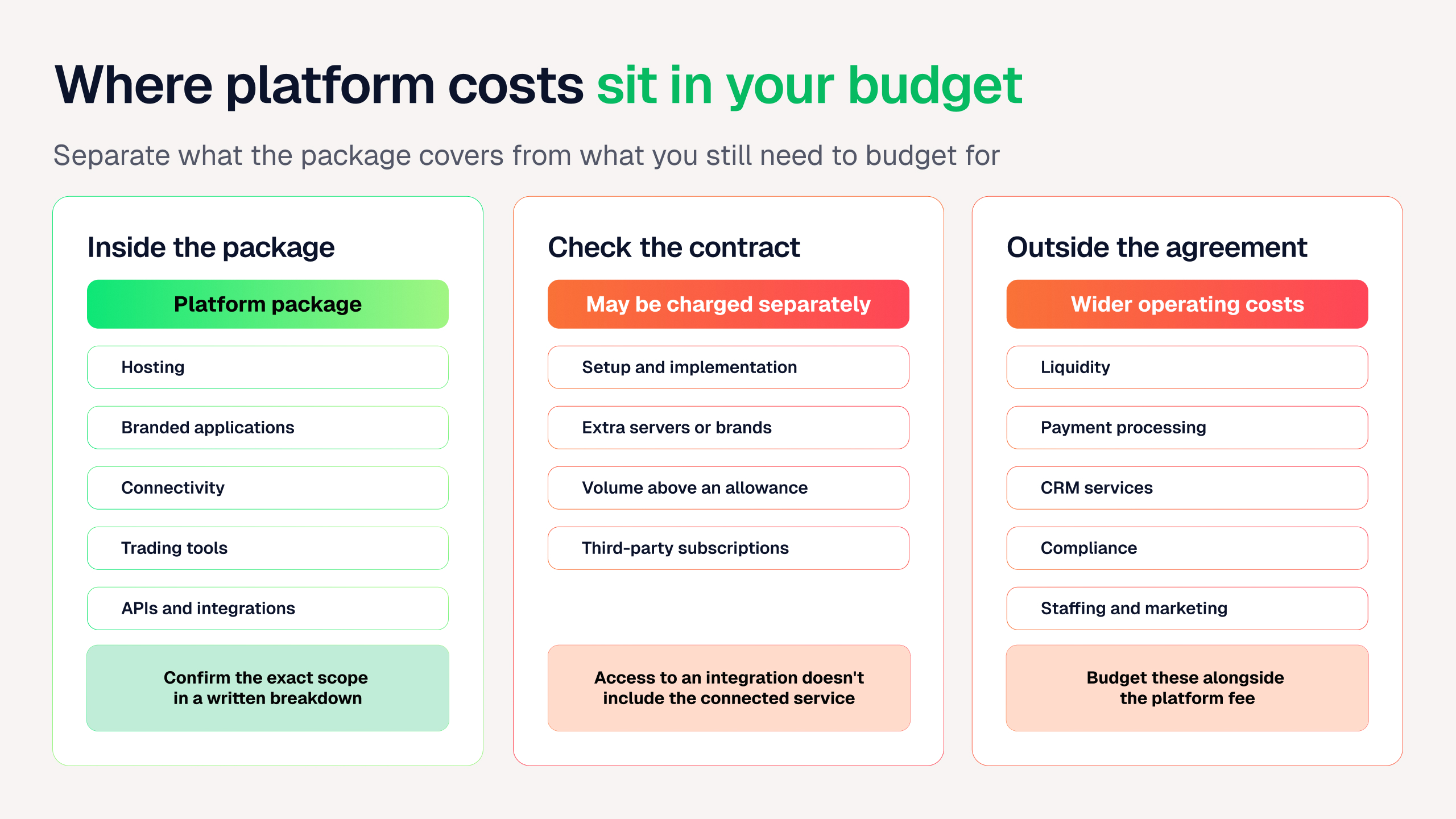
Start by separating platform access from the wider cost of operating a brokerage. A platform package may include hosting, branded applications, connectivity and trading tools. Other services may require separate agreements.
Ask for a written breakdown of recurring fees, setup charges and optional services. Check whether APIs and integrations are included, whether implementation work is chargeable and which third-party subscriptions you still need.
Liquidity, payment processing, CRM services, compliance, staffing and marketing can all create costs outside the platform agreement. Client-facing spreads and commissions belong in the revenue model; provider fees and execution costs belong in the cost model. Keeping these separate makes margin forecasts more useful.
Active-account pricing
How it works
The provider charges according to the number of accounts classified as active during a billing period. The contract may use a fee per active account, account bands or a minimum account commitment.
The definition of active is essential. Check which events qualify an account for billing and whether multiple accounts belonging to one trader are counted separately. Registered users, funded accounts and billable active accounts are not necessarily the same number.
What it offers
This structure gives you an account-based planning metric. If your team can forecast trader activation and retention, it can estimate the billable account base and connect it to acquisition plans.
What to consider
Minimum commitments and tier thresholds can affect the bill even when activity is limited. Confirm how dormant accounts, reactivated accounts and mid-month changes are treated. Also establish whether trading volume or additional services create separate charges.
Volume pricing
How it works
The platform fee is linked to trading volume. The billing unit may be a lot, a million units of notional value or another contractually defined measure.
Confirm how each asset class is counted, which currency is used and whether opening and closing transactions are both included. A headline rate is meaningful only when the measurement method is clear.
What it offers
The usage-based component follows trading activity. Where there is no minimum commitment, that component falls when billable volume falls. This can help a brokerage align part of its technology expenditure with actual platform use.
What to consider
The invoice changes with billable volume, so forecasts need to account for variations in client activity. Minimum fees, volume bands and discounts can also affect the calculation. Track platform charges separately from liquidity or bridge fees, even when both use volume as a billing measure.
Fixed monthly pricing
How it works
The broker pays a recurring fee for a defined package. Within the agreed scope, this fee does not change with each additional trade or active account.
What it offers
A known recurring charge gives your finance team a stable budget line. It can simplify cash flow planning when the required configuration and services are already clear.
What to consider
The fee remains payable during quieter months. Fixed pricing also needs a defined scope: extra servers, brands, services or capacity may require a different package. Check the contract term, renewal conditions and any setup or implementation charges.
Fixed monthly pricing with included volume
How it works
The recurring fee covers a platform package and a specified amount of trading volume. Once billable volume exceeds that allowance, an agreed additional rate applies.
What it offers
You can budget around a known base fee and monitor how much of the allowance has been used. A clearly defined threshold also gives your team a practical point at which to update its forecast.
What to consider
The base fee remains payable when the allowance is not fully used. Above the threshold, total charges depend on the additional volume. Confirm the allowance period, calculation method and overage rate, including whether unused volume carries forward.
What happens when your brokerage grows?
Different pricing models affect costs and budgeting differently as your business scales.
Growth scenario
Active-account pricing
Volume pricing
Fixed monthly pricing
Fixed monthly pricing with included volume
Startup broker
Minimum account commitments can mean paying for capacity before your client base grows.
Low trading volume can keep usage charges low, subject to minimum fees.
The full monthly fee is payable while the brokerage is still building activity.
Hosted infrastructure, branded apps and included trading volume help reduce separate launch expenses.
Growth stage
More billable accounts can increase costs or trigger a higher pricing tier.
Higher trading volume increases usage charges.
The monthly fee stays stable as the business grows within the agreed scope.
Unlimited trading accounts support client growth without a fee for each additional account.
High-volume client base
Under account-only pricing, more trading per account does not increase the fee.
Heavy trading activity can generate substantial volume charges.
A fixed fee supports budgeting within the agreed capacity.
Included volume covers activity up to the allowance, with an agreed rate for budgeting beyond it.
Low-volatility month
Fewer billable active accounts can reduce charges, subject to minimum commitments.
Lower trading volume can reduce usage charges.
The full monthly fee remains payable even when platform usage falls.
A known base fee supports cash flow planning while included infrastructure and tools remain available.
Volatility spike
A surge in billable active accounts can push the brokerage into a higher pricing tier.
A sudden increase in volume can push charges above the forecast.
The monthly fee remains stable within the agreed package terms.
The volume allowance absorbs additional activity up to its threshold before overage charges apply.
Established broker expanding tools and services
Additional tools and services can add charges beyond account fees.
Separate service fees can accumulate alongside volume charges.
New capabilities or configurations may require a package upgrade.
Built-in tools can reduce separate development and procurement needs, while APIs support further expansion.
This is why broker platform fees should be assessed against real client flow. A broker focused on low-frequency retail traders has a different cost profile from one serving high-volume scalpers, algo users or larger-ticket clients. A low starting price may not produce the best economics once the client base changes.
What brokers should ask before choosing a platform pricing model
Before selecting a trading platform vendor, brokers should ask a few practical questions to determine the best fit for their business model:
Fee structure
Is the fee based on trading volume, a monthly subscription, included volume or a combination?
How much trading volume is included in the monthly fee?
What additional fee applies after the included volume threshold is exceeded?
Are there pricing bands, thresholds or overage rules that could affect forecasting?
Growth planning
Can the model support both startup growth and established broker scale?
How predictable is the monthly cost during high-volume periods?
How does the pricing support acquisition, retention and margin planning?
How does the model behave if high-value clients, IB channels or algo users generate more volume than expected?
Package value
Are there additional fees for hosting, branded apps, LP connections, APIs, market content, copy trading, signals, analytics, CRM/KYC/payment integrations or partner tools?
What is included in the package besides access to the trading platform?
How much extra infrastructure would the broker need to build or buy separately?
Those final questions are often the most revealing. Trading platform pricing should not be judged only by access to the terminal. It should be judged by the full operating value included in the package.
Where cTrader fits
cTrader is more than trading platform access. It gives FX/CFD brokers a complete platform solution built around transparency, flexibility and innovation.
Its current FX/CFD broker package follows a fixed monthly pricing structure with included volume. Brokers receive a predictable monthly baseline, unlimited trading accounts and $1B of included trading volume, with an additional fee applying only after the included threshold is exceeded.
That structure is particularly useful as brokers grow. Some scale through broad acquisition campaigns, while others rely on premium traders, IB networks, algo users or active client segments that generate significant trading volume. When platform fees are tied to every lot traded, forecasting costs across these different growth scenarios becomes more challenging.
But predictable pricing is only part of the equation. Brokers also need to consider what is already included in the platform package and how much additional investment would be required to build a complete trading environment.
The package includes:
unlimited trading accounts
$1B of included trading volume
broker-branded apps with an opportunity for mobile advertising
main and backup server hosting
a global proxy network, including Mainland China
the cTrader Leads programme
unlimited LP connections
built-in social and algo trading
24/7 cloud execution for cBots without a VPS
built-in market news and an economic calendar
With infrastructure, trading tools and acquisition capabilities included in the package, brokers can assess their platform costs more clearly and reduce the need to source essential services separately.
Tools for acquisition and expansion
cTrader gives brokers more ways to attract clients, grow their partner networks and enter new markets.
cTrader Leads – Reach a global community of active traders actively exploring cTrader products, gain new leads and boost convertion to live trading with no upfront acquisition cost.
cTrader Invite – Power your IB network with product-led acquisition and attribution.
Multi-platform plugins – Build exclusive tools and services for your clients in cTrader or feature them in cTrader Store to reach a wider audience and generate new leads.
Mobile acquisition – Attract new traders through your branded mobile apps, track campaign performance and measure conversions with mobile attribution capabilities.
cTrader is a cost-effective way to launch
Launching a brokerage comes with substantial upfront technology costs. Beyond the trading platform itself, you'll need branded apps, hosting, client acquisition tools and connections to third-party services. These expenses can add up quickly, even before you onboard your first trader.
cTrader helps you keep these costs under control by bringing essential trading technology into one offering. You get broker-branded web, desktop and mobile applications, hosted infrastructure and built-in copy and algorithmic trading, alongside tools to attract and engage clients. This reduces the need to develop multiple solutions independently or manage separate technology providers.
With unlimited trading accounts, you can grow your client base without paying for additional account capacity as you expand. Instead, you can focus your resources on acquiring traders and growing trading volumes.
Ready to map out your launch?
See what you need to get your brokerage up and running and how cTrader helps you launch faster without building everything from scratch.
Trading platform pricing is a growth decision as much as a technology decision. It affects how clearly a broker can plan costs, protect margins and scale active traders as the business expands.
Volume-fee models can offer a low entry point, but costs rise with trading activity. Fixed monthly pricing with included volume gives brokers a clearer baseline, defined included volume and transparent overage rules.
The right pricing model depends on the broker’s client profile, acquisition plans, trading activity and infrastructure needs. Predictability supports cleaner planning. For established brokers, package depth and total cost of ownership become even more important.
cTrader brings these elements together through fixed monthly pricing with included volume and a broad FX/CFD broker package. For brokers planning both startup growth and established scale, this makes the trading platform cost easier to understand, forecast and manage.
Talk to our Sales team to learn how cTrader can help build a more predictable and scalable trading platform cost structure.