
An introduction to social and copy trading
For a brokerage, social trading and copy trading are not marketing buzzwords; they are product decisions that shape economics, client experience and competitive positioning.
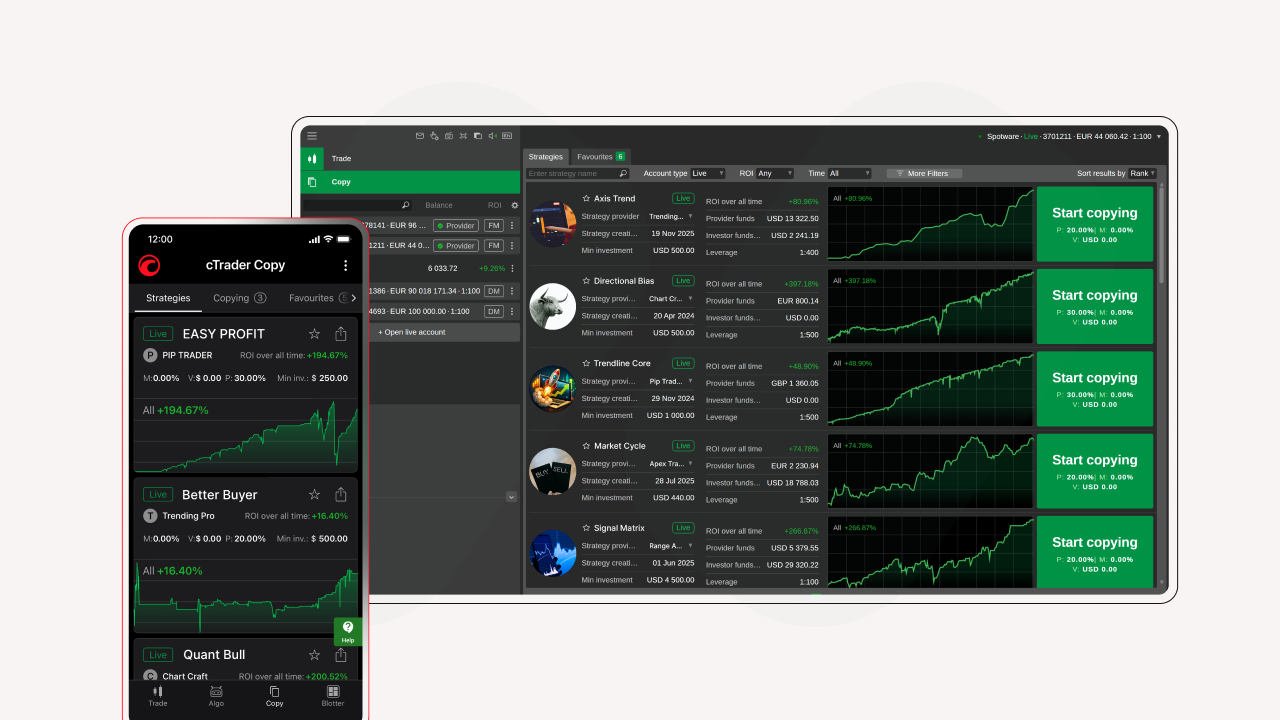
Social trading refers to the broader environment where traders can see, follow and benchmark each other’s ideas and performance. Copy trading is the executable layer on top of that social fabric: investors allocate capital so that their accounts automatically mirror the trades of a chosen strategy provider. Modern platforms also give brokers granular control over copy activity via risk limits, allocation rules and compliance visibility, so social and copy trading operate inside the firm’s risk framework.
From a broker’s perspective, the value proposition is compelling because it directly addresses three chronic challenges:
- Differentiation in an overcrowded FX/CFD market, where spreads are commoditised and platforms look interchangeable.
- Activation clients who open accounts but do not progress into sustained trading activity.
- Reactivation of clients who open accounts, trade once or twice, and then go dormant.
- Partner growth, where IBs, affiliates and proprietary traders can be turned into strategy providers and distribution partners in one move.
When designed properly, social and copy trading become self-reinforcing revenue engines, driving more funded accounts, more volume per client and higher partner productivity off the same core brokerage infrastructure.
Spotware’s cTrader Copy is the social-trading and investment layer built into the broader cTrader environment, fully integrated with the cTrader platform. It lets brokers support strategy providers, attract investors and route the resulting flow through existing pricing, risk and reporting infrastructure across Windows, Mac, Web, Android and iOS. Because cTrader Copy operates across participating brokers, you can choose to offer clients access to a broader pool of strategies beyond your own brokerage, expanding choice and potentially increasing aggregate traded volume.
The strategic question for founders and C-level executives is no longer whether to add social trading, but how to deploy it to consistently improve conversion, volume and lifetime value without creating operational complexity.
Talk to our Sales team to learn how cTrader can help you integrate copy trading into a modern, multi-asset brokerage stack.
Social and copy trading fundamentals for brokers
To design copy trading as a scalable business line and board-level product, let’s define the environment in broker language.
Strategy providers
Strategy providers are the participants who publish strategies that investors can copy in your environment. They can be experienced retail clients, proprietary desks, IBs and affiliates. cBot developers may also benefit by becoming strategy providers. What they have in common is a live trading account and a verifiable performance history.
In cTrader Copy, a provider’s trading activity can only be exposed as a strategy when eligibility requirements are met. Not every trading account is suitable. Brokers typically apply eligibility or quality criteria before strategies are made available to investors, aligned with internal governance and regulatory expectations.
A strategy is defined as the aggregated actions of a trader that are made available for copying, together with parameters such as minimum investment, fee model and visibility.
The provider continues to trade as usual from their trading account. The strategy wrapper handles investor allocations, fees and statistics.
Investors
Investors are the clients who allocate capital to copy a strategy. They might be new to trading, time-poor professionals, or experienced traders who want to diversify into styles or instruments they do not usually trade manually.
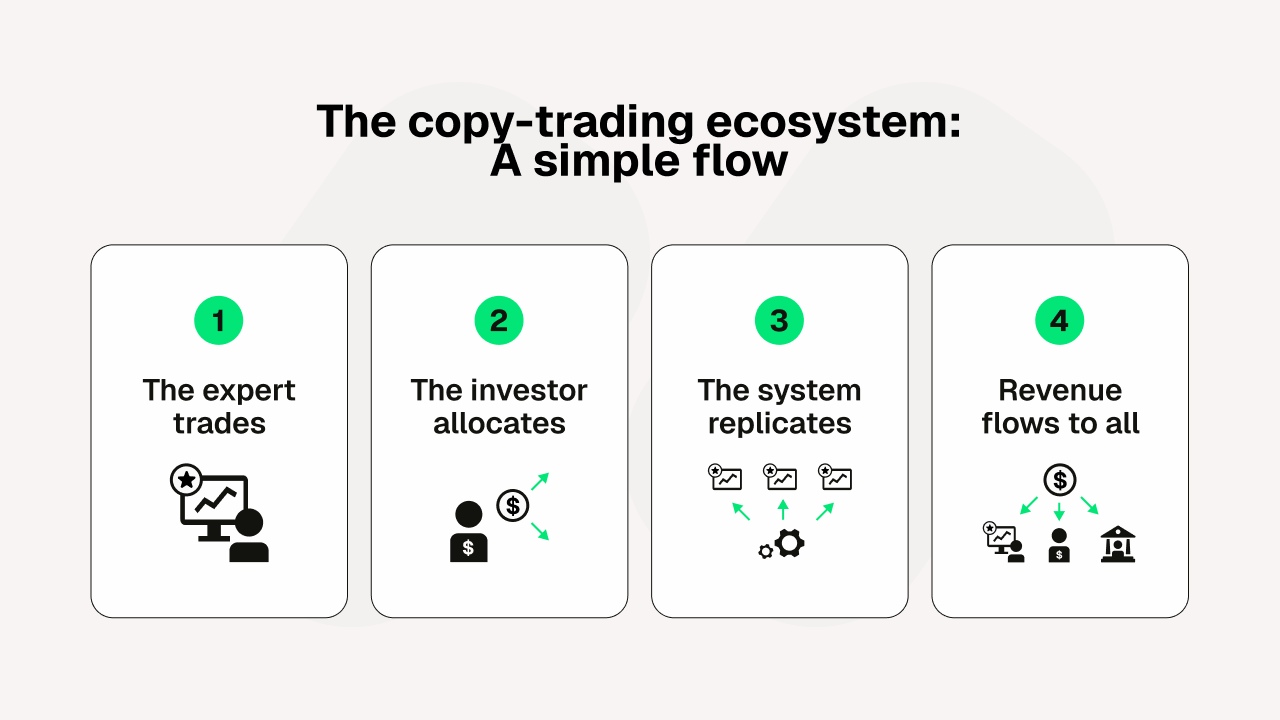
When an investor chooses a strategy in cTrader Copy, the platform creates a dedicated copy-trading account under the same cTrader ID (cTID). Funds are allocated from the investor’s trading account to create a dedicated copy-trading account for that strategy, which is used exclusively for copying.
This design ring-fences the strategy: P&L, risk controls and performance are tracked independently of any manual trading accounts the investor may have.
Strategies, copy accounts, and fee models
In cTrader Copy, the core objects are:
- Strategy - aggregated actions of a trader provided for copying to investors.
- Investor - a trader who allocates funds to copy a strategy.
- Copy-trading account - an account created by allocating funds from a trading account to copy a specific strategy.
Each strategy also specifies a minimum investment amount. Investors may allocate more than the minimum if they prefer, but while copying is active, funds below this minimum investment requirement cannot be withdrawn.
On top of this, there is the fee layer that cTrader Copy supports:
- Performance fees are typically calculated on a high-water-mark basis, so providers are rewarded when investors reach new equity highs.
- Management fees are charged periodically on assets under management.
- Volume fees, charged per notional million copied.
All fees are calculated and charged at the copy-trading account level, ensuring a clean separation of P&L, allocations and fee attribution.
These models allow you to position strategies as performance-aligned products, more traditional “managed” offerings or hybrids, depending on your regulatory and commercial setup.
Value flows from a broker's standpoint
The economics are simple to communicate internally.
First, the broker continues to earn through existing spreads and/or commissions on all trades executed in investor copy-trading accounts just as on standard live accounts. Because investors typically hold positions longer and diversify across multiple strategies, copy trading tends to increase both trade frequency and notional volume. cTrader Copy is a built-in social-trading platform within the cTrader suite, so it uses your existing execution infrastructure rather than a separate stack.
Second, strategy fees flow from investors to strategy providers according to the agreed fee model. Depending on jurisdiction and licence conditions, the broker may also participate in these fees (for example, sharing performance or volume fees with providers).
The result is a social-trading layer that can support incremental revenue growth without forcing a new asset class or exotic payoff structure into the business model.
How copy trading works in practice with cTrader Copy
In parallel with the in-platform cTrader Copy app, cTrader Store acts as a dynamic marketplace for cBots, indicators, multi-platform plugins, desktop plugins and cross-broker copy strategies. Traders can discover and manage these strategies under a single cTrader ID, with cloud synchronisation across all cTrader apps that keeps active clients engaged for longer and gives new investors more ways to stay in your environment over time.
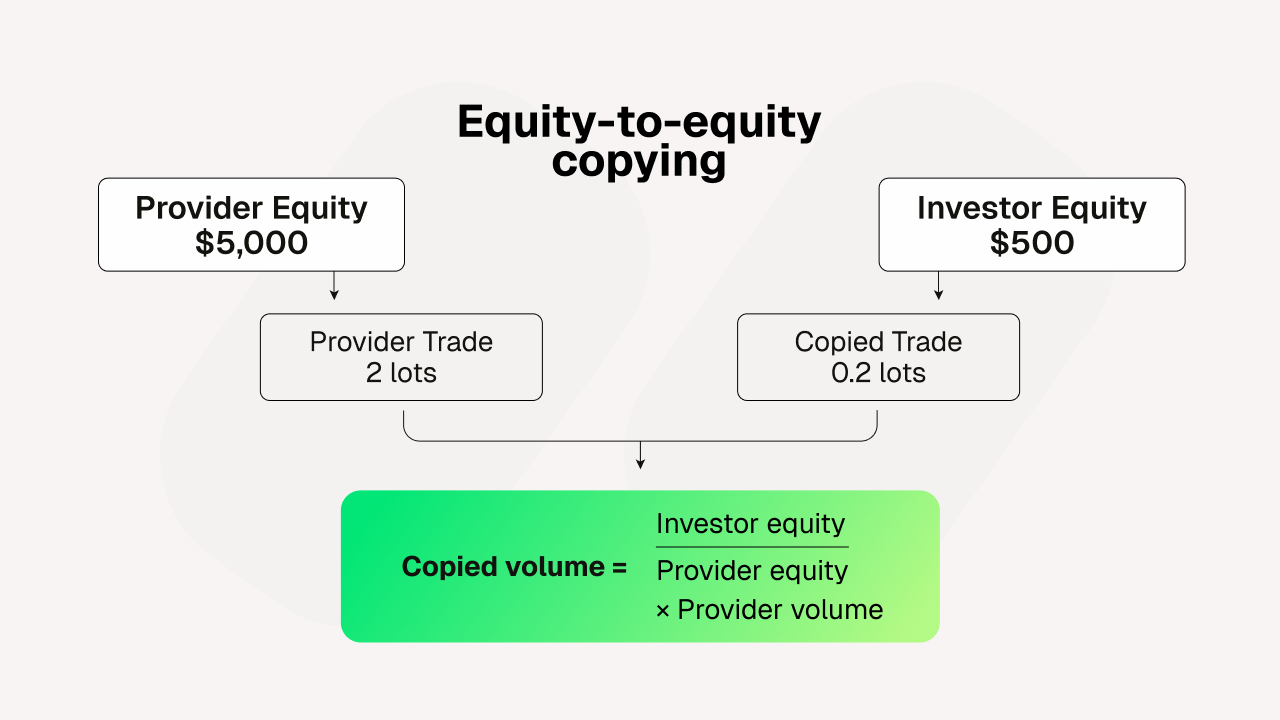
Under the hood, cTrader Copy is built around a simple principle: equity-to-equity copying. The structure is what makes copy trading fair and scalable. A single strategy can be followed by hundreds of investors with different account sizes, but each sees risk and performance proportionate to their equity.
Equity-to-equity copying
Instead of copying raw lot sizes, cTrader Copy sizes each investor’s trade based on the ratio of the investor’s equity to the strategy provider’s equity at the time of the trade. Copying volume is defined as follows:
Investor’s Equity ÷ Strategy Provider’s Equity × Strategy Provider’s Volume
Example:
- Strategy provider equity: EUR 5,000
- Provider trade: 2 lots
- Investor equity: EUR 500
Copied volume:
500 ÷ 5,000 × 2 = 0.2 lots
Order replication and position management
The general copying logic in cTrader Copy is straightforward. The funds allocated from the investor’s account are moved to a copy-trading account. The strategy provider then executes trades from their trading account, and all investors who copy that strategy automatically copy those trades. If the provider modifies open positions (for example, closing or partially closing them), the same actions are applied to the investors’ copy-trading accounts.
cTrader can automatically adjust the volume of open positions and future trades if the provider or investor deposits or withdraws funds, keeping the equity relationship aligned over time. It should be noted that this recalculation is not guaranteed for all open positions and is subject to platform and broker constraints.
There are clear cases where trades will not be copied, including:
- Insufficient funds in the investor’s account.
- The investor lacks the trading instruments the provider uses.
- The investor’s leverage is lower than the provider’s, leaving insufficient free margin to copy all trades.
Additionally, cTrader Copy forbids copying trades in symbols representing stocks and shares. Providers can still trade these symbols (e.g. AAPL, TSLA) in their own accounts, but those positions will not be available for investors to copy.
Investor controls and risk tools
Copy trading only works long-term if investors feel in control rather than locked into a black box.
In cTrader Copy, investors can:
- Start or stop copying a strategy at any time.
When an investor stops copying, the strategy is disconnected, and copied positions are closed in line with platform rules (immediately if the market is open, or once the relevant market reopens). Any applicable outstanding performance and management fees are then charged and realised at the copy-account level in accordance with the strategy’s fee model.
- Adjust the amount of funds allocated to any strategy.
Investors can increase or decrease their allocation while copying is active, but the balance cannot be reduced below the strategy’s minimum investment unless copying is stopped.
- Use equity protection (equity stop-loss) at the copy-account level to cap losses on that strategy.
Equity protection allows the investor to set a hard loss threshold. If the copy-trading account’s equity falls to that level, copying can be stopped, and positions can be closed according to the platform’s rules, giving clients a clear “worst-case” boundary at the account level.
Transparency, reporting, and execution quality
For regulated brokers, copy trading has to meet the same standards of transparency and auditability as any other trading product.
cTrader Copy surfaces detailed statistics for each strategy, including ROI across multiple timeframes, equity, volume breakdowns by instrument, total investor funds and complete trade history. This combination gives investors the evidence they need to make decisions and provides compliance teams with an auditable data trail.
Execution runs within the broader cTrader environment, using the same pricing, routing and reporting stack as manual and algorithmic trading. cTrader Copy is a fully integrated cTrader application; brokers and clients access it across Windows, Mac, Web, Android and iOS without separate logins or detached systems.
Business impact for brokers: focusing on KPIs
Acquisition and conversion
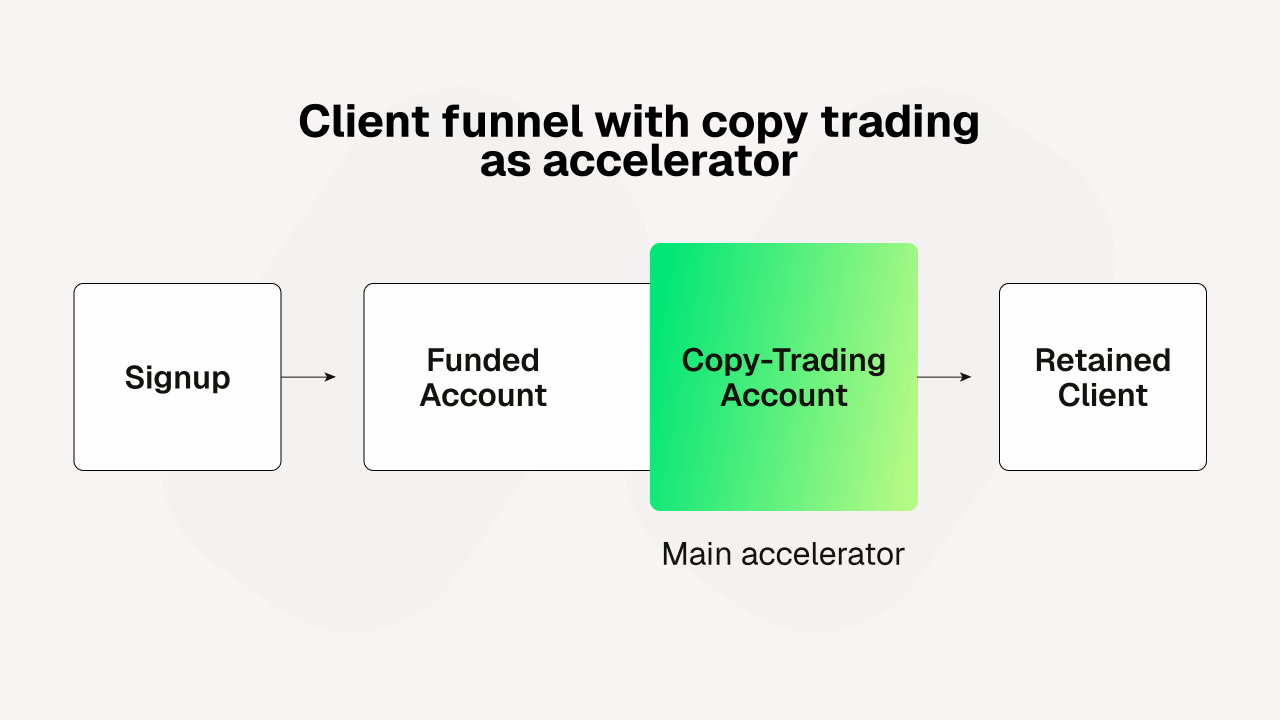
Most brokers carry a long tail of “curious” registrations that never move beyond demo or unfunded status. These prospects often cite lack of time, confidence or expertise as reasons for not trading.
Copy trading offers a different entry point. Instead of being asked to design and execute their own strategy, clients can review live strategies with transparent performance histories, allocate a defined amount, and rely on clear controls such as equity protection. The message shifts from “learn to trade first” to “start with a structured, transparent way to participate and learn.”
Brokers that integrate cTrader Copy into onboarding flows - via email, in-platform messaging and mobile prompts – can systematically convert a portion of dormant or hesitant prospective traders into funded copy accounts, accelerating time-to-first-trade without stepping outside disclosure or appropriateness frameworks.
Volume and retention
Once a client becomes an investor in one or more strategies, ongoing volume is no longer tied solely to the client’s own discipline or screen time. Strategy providers continue trading as part of their regular activity, and copy accounts generate turnover accordingly.
The social and community layer also supports retention. Investors who see transparent statistics, a wide range of strategies and clear risk tools are more likely to rebalance and diversify rather than churn: redeploying capital to different providers, splitting funds across several strategies, or scaling allocations as their confidence grows. Each of these behaviours extends the client lifecycle and deepens engagement.
IB growth and support
IBs can be repositioned in a social-trading model.
An IB or affiliate who becomes a successful strategy provider has two revenue streams: traditional rebates linked to referred volume, and strategy fees from investors copying their trades. cTrader Copy supports this by providing a toolkit for partners: they can share strategy links that attribute users within cTrader, showcase strategies on profile pages and even embed them as widgets on external websites.
The result is a programme where top performers build their own investor bases inside your cTrader environment, while you track referrals and activity through the same infrastructure.
Unit economics and operating model
From a unit economics standpoint, copy trading increases utilisation of existing technology and licences.
You do not need to onboard a new asset class. You do not need parallel infrastructure. cTrader Copy is a built-in component of the cTrader suite, so copy-trading accounts run on the same platform, market data and liquidity as your core FX/CFD offering, with specific rules applied for instruments such as stocks that cannot be copied.
Where regulation permits, you can add a layer of strategy fees on top of spreads and commissions, improving revenue per client without radically changing the operating model.
Risk, compliance and governance
Copy trading also has to pass regulatory scrutiny. Supervisors treat imitative trading models as complex services that require strong governance, not as “social media layers” bolted onto a trading platform.
Clear risk communication
Investors should see plain-language risk disclaimers and explanations of copy trading:
- Does not guarantee profit, and past performance is not a reliable indicator of future results.
- Can incur significant drawdowns and losses.
- May produce different outcomes for providers and investors due to spreads, slippage, timing and leverage differences.
These messages belong in onboarding flows, on strategy pages, and in ongoing communications, and they need to be consistent across marketing, legal and support teams.
Transparent performance and data integrity
Performance statistics must be calculated consistently and presented in a way that is both client-friendly and audit-ready. Metrics such as ROI over multiple horizons, equity, maximum drawdown, volume breakdowns and total investor funds per strategy give risk and compliance teams a live view of where exposure is building and whether behaviour remains within policy.
Because cTrader Copy is fully integrated with the cTrader platform, these metrics sit within the same data and reporting stack as the rest of your business rather than in a siloed third-party system.
Fair treatment and conflicts
Fee models should follow published rules, such as high-water-mark calculations for performance fees, and be fully disclosed before an investor commits funds. If the broker shares in strategy fees, that relationship needs to be documented and aligned with local conduct requirements.
The objective is simple: investors understand what they are paying, strategy providers know what they are earning, and the broker can demonstrate that incentives are not misaligned with client outcomes.
Technology as a governance enabler
cTrader Copy is built to support governance rather than circumvent it. cTrader provides the technology layer, while the broker defines the commercial, regulatory and operational rules that govern how copy trading is offered and supervised.
- Investor-side controls, such as equity protection and the ability to stop copying immediately, make risk controls tangible for clients.
- Broker-side access via cTrader Admin and reporting APIs lets you monitor strategies, investor flow, and concentrations in real time, using the same infrastructure as your other cTrader services.
- Brokers can configure whether strategies are visible only to their own clients or to all full members of cTrader Copy, and align this with their own client segmentation and policy framework.
The platform provides the levers; your governance sets how far each lever can be pulled.
Implementation scenarios: typical broker playbooks
To move from concept to execution, it helps to anchor copy trading in specific use cases. Three scenarios recur among brokers who deploy cTrader Copy as a growth driver.
Activating the existing client base
Many brokers experience similar early-stage conversion challenges. Users who remain stuck in demo mode, and newly registered live-account holders who never make a first deposit. Copy trading gives brokers a more practical way to address both gaps. For demo users, it lowers the psychological barrier to going live by shifting the message from “trade on your own from day one” to “start with a structured strategy, clear statistics and defined risk controls”. For live-account holders, it creates a stronger reason to fund the account, because the client is not opening a live profile in the abstract but allocating capital to a strategy they can follow from the outset.
A common approach is to segment clients by behaviour and run targeted campaigns that position cTrader Copy as a guided way to participate. They can choose from curated strategies, allocate a modest amount, set equity protection, and monitor from any cTrader app. In-platform banners and notifications can link directly to strategy lists filtered according to your internal quality and risk criteria.
Success is measured by the incremental number of funded copy-trading accounts and also by improved demo-to-live conversion rates, stronger live-to-FTD progression, and the additional trading volume those accounts generate over time.
Improving retentions through ongoing engagement
Retention is a persistent pain point for many brokers. Clients often complete onboarding and initial trading activity, only to lose momentum after the first few trades when markets feel complex, time-consuming or difficult to follow. cTrader Copy helps close that gap. Copy trading can help extend the client lifecycle by providing a more structured way to stay involved. Instead of relying entirely on their own ideas, investors can follow strategies, adjust allocations, and monitor outcomes through the same platform, which supports a more continuous relationship with the broker’s offering.
Building a partner-driven growth engine
In a partner-led model, your top IBs, affiliates and proprietary traders can become strategy providers with their own investor communities on your platform.
You define the fee framework, eligibility criteria and visibility rules. cTrader Copy provides the tooling: providers can publish their strategies, showcase performance on cTrader profile pages and use shareable links or widgets embedded on their own channels to drive traffic.
Their marketing drives traders into your cTrader environment, and their performance attracts investors who generate ongoing flow. Over time, this creates an environment where strong performers are more deeply integrated into your stack and less inclined to scatter their flow across multiple venues.
Positioning for specific segments or regions
In some regions or client segments, selling pure self-directed trading is challenging. Beginners may feel intimidated; busy professionals may be interested in markets but unable to commit the time.
Copy trading lets you lead with a different narrative. In a new market, you might launch with a locally branded social-trading proposition that puts vetted strategies, transparent statistics and clear risk tools front and centre. cTrader Copy’s configurable strategy availability helps you align which strategies are visible with your regulatory posture and internal risk appetite, while language, payments and support remain fully localised under your brand.
Conclusion
Social and copy trading have evolved into strategic product lines that can improve conversion rates, increase traded volume and extend client lifecycles when designed correctly.
Copy trading is more than just an added platform feature, it is a practical way to close some of the biggest commercial gaps in the FX/CFD model. It can help move more users from registration to funded activity, reduce the drop-off that often follows the first few trades, and give brokers a better chance of reducing trader churn to other platforms.
There is a direct business value. More funded and active clients can support higher trading volume. Longer-lasting client engagement can improve retention and lifetime value and a stronger social-trading proposition can also help brokers compete more effectively in a market where many offerings still look interchangeable to the end user.
cTrader Copy supports that model by giving brokers an integrated way to offer copy trading within the broader cTrader environment, while aligning strategy access, visibility, fees and oversight with their own commercial and governance framework. For firms looking to improve conversion, keep clients active for longer and build a more competitive trading ecosystem, copy trading is no longer peripheral, it is becoming part of the core brokerage proposition.
Talk to our Sales team to learn how cTrader and cTrader Copy can help you implement a spread-based trading model with integrated social and copy trading, with the level of control your regulators, partners and shareholders expect.