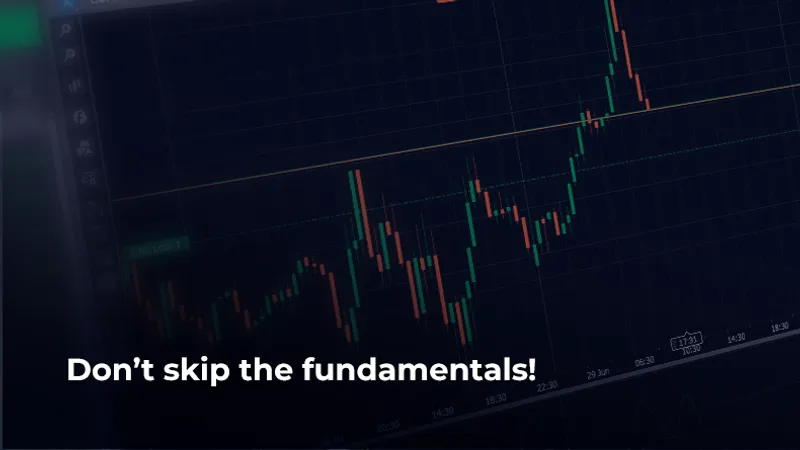
The first thing you will learn as soon as you start your educational journey in the trading world is technical analysis. Technical analysis, as a trading technique, tries to predict future price movements based purely on past market data.
Technical analysis fanatics advocate that, in order to make favourable predictions about the future, there is nothing else you need to know about the world except the past prices and volume. According to them, you can lock yourself in a room, stare at the chart of any asset pair and make a profit based on some predefined rules and guidelines. You do not really need to know anything about the context in which the trading is taking place. All in all, not much of a difference from a tarot card reading.
There are two reasons why this trend is dominant especially in the retail trading industry - it’s easy to practice and cheap! The most valuable resource when it comes to trading and investment is information and information has a price tag. Technical analysis does not require much of it. Just past prices which are then fed into some of the gazillions of available indicators and pattern detectors out there and here you go - you have a fortune teller! When the indicators state is X then it’s better to buy and when the indicators state is Y, your best bet would be to sell. Follow the recipe and you will be successful! At least that is what the theory says...
The other side of the narrative is to use fundamental analysis. You will hear about fundamental analysis in the introduction part of numerous available trading courses but more or less that’s it. Fundamental analysis is hard for introductory courses to dive into. It is much more than trading the GDP and the NFP. It requires a deep knowledge of the underlying industry and the relevant forces that drive it. This means access to a lot of information which is time-consuming to gather, hard to interpret and sometimes costly, i.e. access to a Bloomberg Terminal.
It also requires a certain educational background to be able to translate the information into insights about the future. For example, you need to have a solid background in economics and finance. It is a form of analysis not easily accessible to amateurs, hence it is skilfully skipped when training entry-level retail traders. A common advice a retail trader will get when trading is “Don’t trade the news”. This is just a disguised version for “Don’t trade something you do not understand”.
While technical analysis is not useless per se, on the contrary, it is an excellent tool as it is based on solid behavioural economics, it is also dangerous when used out of context. In the pandemic era, the need for understanding the fundamental forces of the economy becomes more prominent and highlights the importance of fundamental analysis. If you have been trading stocks, indices or commodities during this period, only using technical analysis, then you probably haven’t done so well, since it is likely that you have received numerous false signals.
There is not much a stochastic indicator can tell you about a price war between the Saudis and the Russians, or a MACD about the Sino-American trade disputes or the recent market-disruptive Trump tweets. To make sense of what is happening on a chart, you need to look beyond it and understand what is going on in the world nowadays. You need to know a bit of everything - economics, geopolitics and even a bit of epidemiology.
A rational trading strategy should always be a mixture of fundamental and technical analysis. My personal preference is to establish a long term trend, based on fundamentals and trade this trend using technical analysis to find good entry points. For example, in a world that is gradually reopening from lockdowns, airports resuming operations, people going back to work and planning their vacations, OPEC+ cutting oil production and the market heading towards a supply deficit, don’t short oil no matter what an indicator tells you. Just don’t!
Written by: by Panagiotis Charalampous, Head of Community Management of cTrader at Spotware.
Also published on fxstreet.com